A Complete Guide to CRM Systems and Database Management
 Jeremy Wayne Howell : Jul 22, 2026 9:48:31 PM
8 min read


Most people don’t wake up wanting to talk to sales. Emotionally, the reader is guarded. Cognitively, they’re scanning for risk: wasted time, hidden terms, manipulation, and the fear of making a decision they’ll have to defend internally.
What they believe is wrong is usually tactical: “Our outreach isn’t converting,” “Our reps need better scripts,” or “Leads are weaker than they used to be.”
What is actually wrong is more psychological: the buyer feels uncertainty and a lack of control. Traditional selling amplifies that uncertainty by pushing for commitment before the buyer has clarity.
That’s why disruptive sales strategies matter. They challenge traditional selling by engaging buyers before they’ve fully named the problem, and they prioritize transparency, unconsidered needs, and value-first interactions over feature-driven pressure.
Transparency-First Selling: Publishing pricing, contract terms, and limitations openly to reduce uncertainty and build trust
Value Bomb Prospecting: Delivering highly personalized value before asking for a meeting
Striker Questions: Asking incisive questions that surface unconsidered needs and challenge assumptions
Social Listening and Stealth Nurturing: Building relevance through observation and helpful engagement before pitching
Challenger Sales Methodology: Reframing the customer’s situation to help them see a better path forward
Traditional sales has a trust problem. Only 3% of people say they trust salespeople. Whether the exact number shifts by survey, the lived experience doesn’t: buyers expect persuasion tactics, not clarity.
The typical sales process was built for a world where buyers needed salespeople to access information. That world no longer exists. Buyers now complete most of their decision-making before they speak to a rep. By the time they engage, they’ve already formed a narrative about what “good” looks like and what might go wrong.
Yet most sales teams still behave as if they control the conversation. They lead with features. They ask generic discovery questions. They pitch before they’ve earned the right to be heard.
The result shows up as “no decision.” Not because the buyer chose a competitor, but because the sales experience didn’t reduce uncertainty enough to justify change.
Disruptive selling is not about being louder or more creative. It’s about being more psychologically accurate. Disruptive sellers understand that buyers don’t want to be sold to. They want to feel safe making a decision. They want to be understood, and they want a guide who can name the risks, the tradeoffs, and the path forward.
At The Way How, we help teams implement disruptive sales strategies that align revenue motions to buyer psychology rather than outdated process. When you shift from feature-driven pitches to empathy-driven systems, you restore momentum in stalled pipelines and create the kind of clarity that makes change feel less dangerous.
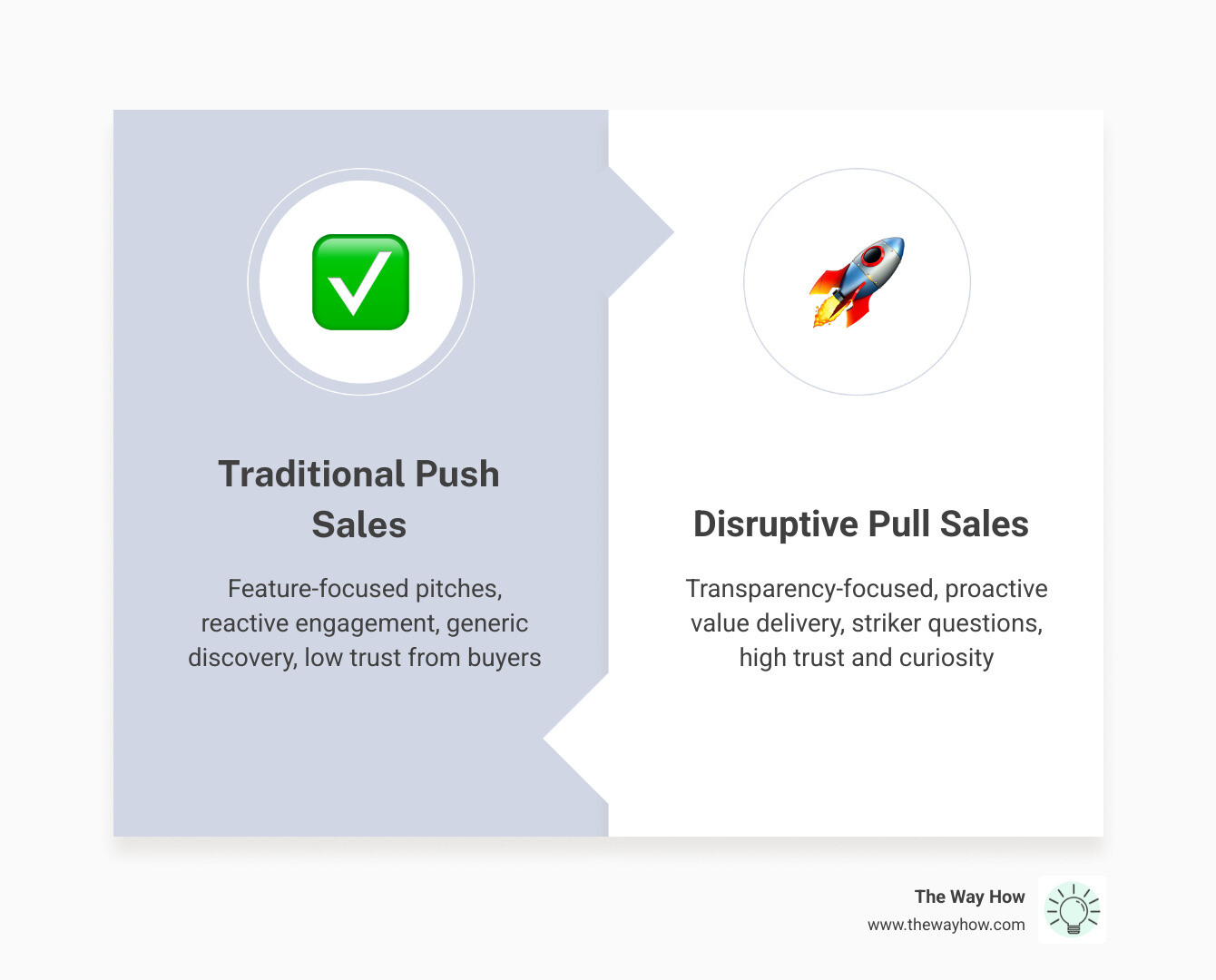
To understand disruption in a sales context, we must first look at what it aims to replace. Traditional selling is often a “me-focused” endeavor. The salesperson has a quota, a script, and a product. They are looking for a “fit” based on known problems.
Disruptive selling, however, is about shattering the status quo. It involves identifying unconsidered needs—the risks or opportunities the buyer hasn’t even noticed yet. When you introduce a problem the buyer didn’t know they had, you stop being a vendor and start being a guide. This is the cornerstone of a modern b2b sales strategy.
True disruption isn’t just about using new technology; it’s about behavioral disruption. It’s the choice to be radically transparent in a world of hidden fees, or the choice to give away your best advice for free to build authority. It’s about meeting the buyer where they actually are, rather than where your CRM says they should be.
The major shift in buyer psychology over the last decade is staggering. In 2010, Amazon made $34.2 billion; by 2020, that number hit $386 billion. This growth reflects a fundamental change: buyers now expect autonomy, speed, and absolute clarity.
Traditional sales strategies are reactive. They wait for a lead to raise their hand and then respond with a feature-dump. This creates friction because the buyer has likely already researched those features.
Disruptive strategies are proactive and education-first. Instead of asking “What keeps you up at night?” (a question that puts the work on the buyer), a disruptive seller says, “We’ve noticed that companies in your position often overlook X, which leads to Y. Here is how to fix it.” You are not just selling a product; you are building a vision of a better future.
To develop a disruptive strategy, we focus on four core pillars:
When decision-makers receive hundreds of generic LinkedIn messages and cold emails, the problem is not volume. The problem is meaning. Most outreach fails because it asks the buyer to do emotional labor for a stranger: to care, to explain, to justify a meeting, to imagine impact with too little information.
A “Value Bomb” works because it reverses the burden of proof. It is a high-effort, highly personalized delivery of value that happens before you ask for time. Psychologically, it reduces the buyer’s uncertainty about three things:
Relevance: “They understand my world.”
Competence: “They’ve solved problems like this.”
Intent: “They’re not just here to extract.”
Consider the example of a salesperson who researches a prospect’s manufacturing bottleneck and sends a tailored teardown of their current process. The disruption is not the gimmick. The disruption is the clarity it creates: the buyer can now see what’s actually happening and what it’s costing them.
One of the most effective ways to deliver a value bomb at scale is to develop an informative and engaging webinar. Most companies get this wrong because they treat the webinar as a delayed pitch. That increases buyer skepticism and reinforces the belief that “marketing content is just sales in disguise.”
A disruptive webinar teaches a specific, defensible point of view about a problem the buyer hasn’t fully named yet. The goal is not to impress. The goal is to help them make sense of their situation.
The real trust-building moment is the follow-up with the participants. Instead of “Thanks for attending,” disruptive teams reflect what they observed. They send a short, personalized insight based on what the buyer asked, avoided, or emphasized. That single act signals empathy and attention, which are the real precursors to conversion.
To do this well, you need more than a tool. You need a posture: curiosity without extraction. Social listening is not about surveillance; it’s about context. By understanding what content a prospect engages with and what challenges they mention publicly, you can offer help that fits their reality.
Start with the principle, then the platform. If you want a tactical definition of social listening, see this guide. If you want to connect it to outbound systems, see our outbound lead generation complete guide.
Used well, stealth nurturing creates a simple psychological outcome: when you finally reach out directly, you are no longer a cold interruption. You are a familiar signal of clarity.
Once you have attention, the goal is not to “handle objections.” It’s to reduce uncertainty by helping the buyer see what they can’t yet see: the hidden cost of the status quo and the real requirements of change.
This is where Striker Questions matter. These are deep, specific questions designed to surface unconsidered needs, quantify risk, and reveal the buyer’s internal constraints.
Most salespeople ask: “What are your goals for this year?”
A disruptive seller asks: “If you keep your current process and the market shifts by 5% next quarter, what is the financial impact on headcount, service levels, or churn, and who will own that outcome internally?”
Striker questions work because they change the buyer’s mental model. They stop thinking in preferences (“I like this vendor”) and start thinking in consequences (“Here is what happens if we do nothing”). That shift is how you create a buying vision without pressure.
This is a core part of effective b2b sales consulting: you are not collecting information; you are helping the buyer make sense of their own environment.
Disruption requires healthy tension, but tension without empathy becomes threat. The buyer’s nervous system reads threat as risk, and risk slows decisions.
Use a simple diagnostic rule: if your “challenge” makes the buyer feel judged, you will get compliance at best and avoidance at worst. If your challenge makes the buyer feel understood, you get collaboration.
Reframe the conversation from price to the cost of inaction and the cost of change
Ground urgency in evidence, not pressure, by naming the specific risks of the status quo
Use narrative to help stakeholders align on what “better” actually means and what it will require
When a deal stalls, the obstacle is rarely your product. It is the buyer’s fear of choosing wrong and having to defend it later.
Striker questions don’t create urgency by force. They create urgency by clarity.
Adopting disruptive sales strategies isn’t just a win for the individual rep; it’s a driver of massive shareholder value. Research shows that for the top-performing companies in the S\&P 500, revenue growth powers 75% of total shareholder return (TSR). Even in the short term, growth accounts for nearly a third of that return.
However, scaling a disruptive product requires a Go-to-Market Revolution. You cannot use 20th-century sales tactics to sell 21st-century innovation. As companies move from early adopters to the mainstream, they must optimize their sales funnels to handle increased volume without losing the “disruptive” edge.
This involves:
The primary risk is buyer indecision. Because disruptive selling often blindsides prospects with problems they didn’t know they had, it can lead to a “deer in the headlights” effect. 58% of deals end in no decision because the buyer feels overwhelmed. To mitigate this, you must provide a clear, structured roadmap and create a sense of urgency that makes staying the same more painful than changing.
They are two sides of the same coin. Disruptive marketing (like the Old Spice ‘Smell Like a Man, Man’ campaign) sets the stage by challenging industry norms and grabbing attention through surrealism or bold claims. Disruptive selling then executes that promise in one-on-one interactions. For a deeper look, see our disruption marketing complete guide.
Absolutely. Small teams are often more agile and can implement disruptive sales strategies faster than large corporations. Techniques like “Social Media Stealth Mode” and highly personalized “Value Bombs” don’t require massive budgets—they require deep research, creativity, and a willingness to building valuable relationships over the long term.
At The Way How, we treat the status quo as the real competitor. Most teams aren’t losing to another vendor; they’re losing to internal uncertainty: unclear priorities, misaligned stakeholders, and a revenue system that creates friction instead of confidence.
When growth stalls, most leaders reach for tactics. More outreach. More content. More meetings. But tactics can’t compensate for a buyer journey that feels unsafe or confusing.
The buyer cannot clearly name the problem, so they cannot justify change
Stakeholders disagree on what “success” means, so momentum dies in internal review
The sales experience increases uncertainty (hidden terms, vague ROI, unclear next steps)
Marketing creates attention but not conviction, so pipeline looks active but won’t convert
We are a psychology-first marketing and revenue strategy firm. Through Fractional CMO leadership and HubSpot architecture, we design demand generation and sales enablement systems rooted in human behavior, empathy, and decision science.
We don’t start by prescribing new tactics. We start by diagnosing where certainty breaks in your customer journey, then build the systems that reduce friction and make progress feel obvious.
Work with The Way How to transform your sales engine and replace stalled momentum with a buyer experience built on clarity.
 Jeremy Wayne Howell : Jul 22, 2026 9:48:31 PM
 Jeremy Wayne Howell : Jul 21, 2026 9:47:10 PM
 Jeremy Wayne Howell : Jul 20, 2026 9:46:47 PM