A Complete Guide to CRM Systems and Database Management
 Jeremy Wayne Howell : Jul 22, 2026 9:48:31 PM
The psychology of marketing is the application of psychological research and principles to understand how people make purchasing decisions, what influences their behavior, and how to create marketing strategies that resonate with their actual motivations—not just what they say they want.
Quick Answer: What You Need to Know
You’ve tried the tactics. The webinars, the funnels, the AI tools, the “growth hacks.” Some worked for a while. Most didn’t. Now you’re stuck watching competitors grow while your pipeline stays flat, and you can’t figure out why.
Here’s what’s actually happening: you’re optimizing for the wrong thing.
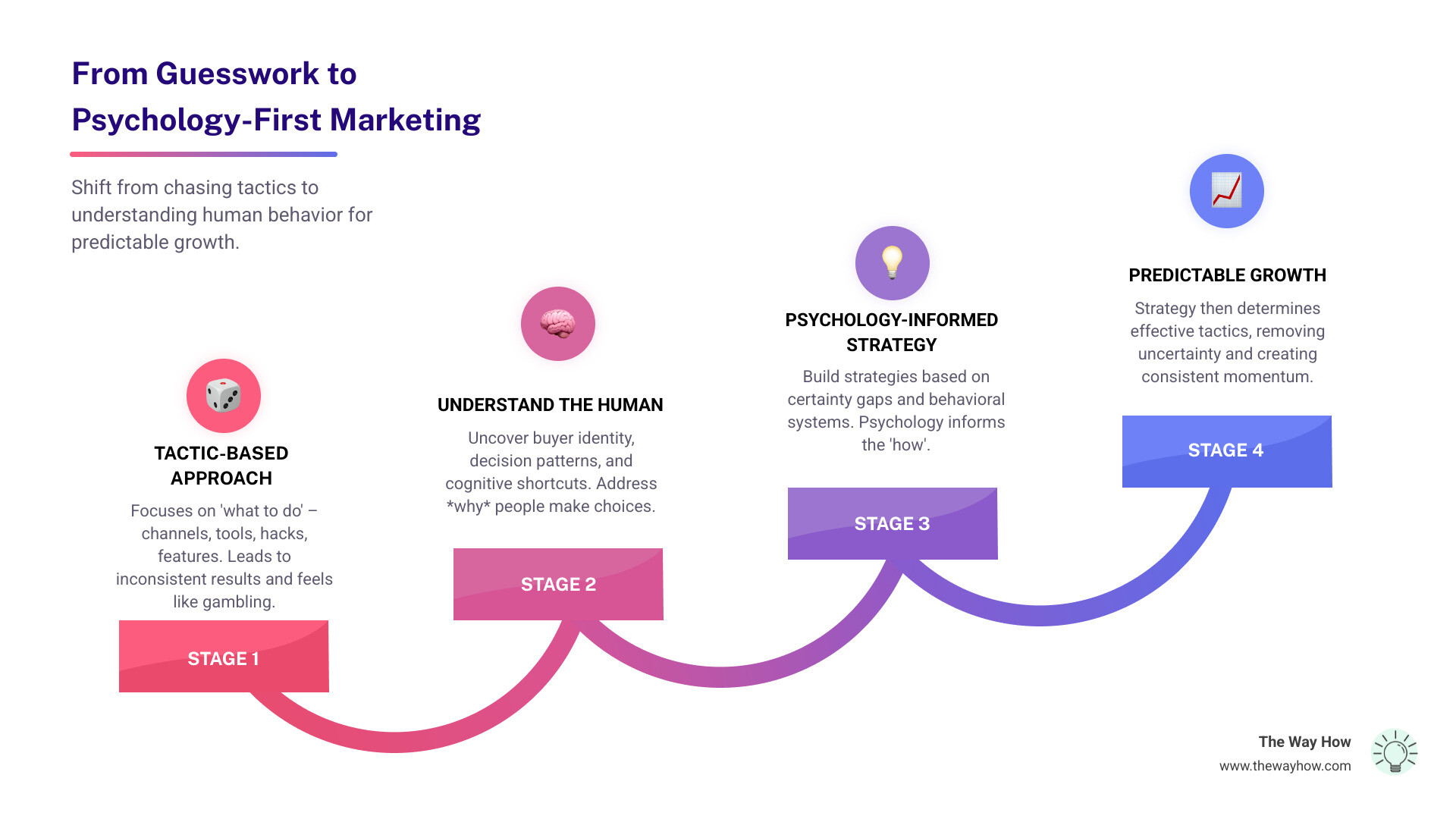
Most marketing advice focuses on what to do—which channel, which headline format, which CTA color. But none of that matters if you don’t understand who you’re talking to and why they make decisions the way they do.
Human behavior doesn’t follow your funnel. It follows patterns shaped by evolution, culture, social identity, and cognitive shortcuts that have nothing to do with your product features. When your marketing ignores these patterns, it feels like gambling because you’re guessing at what will work instead of building on what’s proven about how people think.
The research is clear: ads with higher distinctiveness scores perform significantly better. Concrete language is remembered 8.6 times more than vague phrases. Showing effort increases perceived quality by 14%. Specific numbers (like “47% longer”) are trusted 10% more than round numbers. These aren’t random tips—they’re applications of psychological principles that shape every purchase decision your customers make.
The gap between your current results and predictable growth isn’t about working harder or spending more. It’s about understanding the human on the other side of the transaction before you build your next campaign.
I’m Jeremy Wayne Howell, founder of The Way How, and I’ve spent over 20 years helping revenue teams move from tactic-chasing to building systems rooted in the psychology of marketing and buyer behavior. This guide will show you how to do the same—not through theory, but through principles you can apply immediately to remove uncertainty and create momentum.
Handy psychology of marketing terms:
At its core, marketing psychology is the application of scientific insights into human behavior to commerce. It’s an interdisciplinary field that helps us understand why people choose to buy, use, or reject products and services. We dig into the depths of consumer behavior, exploring the intricate processes of human decision-making—from unconscious biases to conscious evaluations.
What makes marketing psychology so powerful is its reliance on both quantitative and qualitative research. Instead of relying on assumptions or what people say they do in surveys, we look at what they actually do. This scientific approach often reveals that our intuitions about consumer choices are wrong, helping us overcome common misconceptions and build more effective strategies. It’s about diagnosing the true drivers behind stalled growth and identifying certainty gaps in the customer journey.
While closely related, marketing psychology is a broader discipline than behavioral economics. Behavioral economics, often praised for uncovering “systematic irrationalities” in consumer choices, primarily focuses on economic decision-making—how people deviate from rational economic models. It explains how consumers actually behave, as opposed to how they should behave in a perfect economic world.
However, marketing psychology applies the full spectrum of psychological science to marketing and branding. It picks up where behavioral economics leaves off, exploring a much wider field of psychological perspectives, including social, evolutionary, and cultural influences. This means we consider not just the cognitive shortcuts people take when making a purchase, but also the deeper social, emotional, and biological underpinnings of their actions. It’s about understanding the whole human, not just the economic agent. For a deeper dive into the brain’s role, exploring the neuropsychology of consumer behavior and marketing can offer further insights.
Our understanding of consumer behavior is profoundly shaped by three major branches of psychology:
Social Psychology: Humans are inherently social creatures. Our decisions are often influenced by our social identity, our desire to fit in, or to signal our values to others. Brands can tap into these social drives. For example, Jif Peanut Butter famously appealed to mothers with the slogan ‘choosy Moms choose Jif’, leveraging social identity. Similarly, luxury brands allow consumers to signal wealth and status, while sustainable brands signify environmental values. Brands like Budweiser, by associating itself with the ‘American Identity’, or Robinhood, by anchoring its brand to younger investors, demonstrate how social psychology influences brand relationships and product choices.
Evolutionary Psychology: The human brain, while capable of complex thought, is an organ forged through evolutionary pressures. Our modern consumer world is run on what is essentially ancient hardware. This means many of our innate leanings and biases stem from survival instincts. One key principle is the Mere Exposure Effect: the more we are exposed to something, the more we tend to like it. This is why consistent advertising, like Coke’s billions spent on campaigns, can be highly effective, building familiarity and preference over time.
Cultural Psychology: Culture influences nearly every element of human psychology, including how we perceive and interact with brands and products. Brands that ignore the impact of culture on consumer psychology do so at their peril, particularly when expanding into new markets. A classic example is Walmart’s expansion into Germany, where the enthusiastic smiling of store clerks, a norm in the US, was perceived negatively by German shoppers, leading to cultural misunderstandings and operational challenges. Understanding these cultural nuances is crucial for effective global marketing.
Applying psychological principles in marketing is not about manipulation; it’s about ethical persuasion. Our goal is to remove uncertainty and build trust, creating momentum in the customer journey, not to exploit vulnerabilities. Ethical application means providing genuine value, being transparent, and respecting consumer autonomy. When a brand brings you something useful—whether it’s advice, a promo code, or a sample—you’re naturally more inclined to trust them and even buy from them. For more advanced techniques that dig into the brain, consider exploring neuromarketing techniques.
The principle of reciprocity is simple yet powerful: when someone does something for us, we feel a natural urge to return the favor. In marketing, this translates to giving value first. Brands that offer something useful—like high-value content, a free sample (conceptually, a taste of what’s to come), or a helpful tool—build goodwill and make customers more inclined to engage or purchase.
Consider how Sephora fosters loyalty by offering free samples and birthday gifts to its members, creating a sense of being valued and appreciated. These aren’t just perks; they’re acts of giving that trigger a desire for customers to reciprocate, often through continued purchases. By consistently providing value, we build trust and establish a foundation for lasting customer relationships.
Few things motivate action like the fear of loss. The thought of missing out on something valuable often impacts us more emotionally than the pleasure of gaining it. This is where scarcity and urgency come into play.
Interestingly, even how we frame unavailability matters. A study found that using the label “Sold Out” triggered noticeably fewer negative reactions than “Out of Stock.” Participants reported feeling 8% less disappointed about the missing product and 15% less disappointed with the entire website compared to when the product was labeled “Unavailable.” This suggests that “Sold Out” implies high demand and success, rather than a mere inventory issue.
Our perception of value is highly relative, often influenced by the first piece of information we encounter—the “anchor.” This is known as anchoring bias. Once an anchor is set, subsequent information is judged in relation to it.
This principle is crucial in pricing strategy. When we present a premium-priced option first, or show a crossed-out original price alongside a discounted one, the initial higher price serves as an anchor. The discounted price then seems like a much better deal, highlighting the perceived value. Netflix, for example, subtly pushes users towards more expensive plans by highlighting what they ‘gain’ (HD resolution, number of screens) compared to the basic option, making the upgrade seem more beneficial.
Framing, another powerful psychological concept, involves presenting information in a way that influences its interpretation. The same information can elicit different responses depending on how it’s framed. For a comprehensive understanding of how to leverage this, consult our guide to the marketing framing effect. Additionally, dig deeper into the nuances of anchoring bias in marketing to refine your pricing and promotional strategies.
The endowment effect describes our tendency to value something more once we own it, or even perceive ourselves to own it. This intrinsic bias means we demand more to give up an item than we would be willing to pay to acquire it.
Marketers can leverage this by creating opportunities for perceived ownership. Think of free trials, product samples, or test drives (as psychological concepts, not just product offerings). When customers experience a product, even temporarily, they begin to feel a sense of ownership, making it harder to part with it. This increased attachment translates into a higher perceived value and a greater willingness to purchase the item at its full price. For a deeper understanding of this phenomenon, explore understanding the endowment effect in marketing.
At The Way How, we understand that every touchpoint in the customer journey is an opportunity to apply psychological insights to remove uncertainty, create momentum, and ultimately drive predictable revenue. It’s about building systems that anticipate human behavior, rather than reacting to it.
The words we use, and how we present our brand, have a profound psychological impact.
The visual elements of your marketing—from website design to ad creatives—play a critical role in user attention and decision-making.
Psychological principles aren’t confined to general strategy; they can be applied with precision across specific marketing channels:
For us at The Way How, marketing isn’t just about the next sale; it’s about building enduring customer relationships and brand loyalty that translate into long-term value and predictable revenue. This requires a deeper understanding of human connection.
Stronger customer relationships are built on empathy—understanding and valuing your customers. When we treat customers with respect and recognition, we create a lasting bond.
One of the most critical applications of marketing psychology is its ability to challenge our preconceived notions about consumer behavior. What customers tell us in surveys isn’t always what they do. Human psychology frequently counters expectations, and robust research helps us uncover these hidden motivations.
Consider Mason Haire’s classic instant coffee study. When asked directly, consumers often cited taste as a reason they didn’t buy instant coffee. However, a projective technique revealed that many homemakers described users of instant coffee less favorably than users of ground coffee, suggesting that social perception and convenience (laziness) were the real, underlying factors, not taste. This highlights the importance of using psychological research to look beyond surface-level responses and uncover deeper truths. By continuously testing psychological triggers through A/B tests and analyzing behavioral data, we can move beyond assumptions and build truly effective strategies.
The line between ethical persuasion and unethical manipulation can be thin. The biggest ethical considerations in marketing psychology revolve around:
You don’t need a massive budget to start leveraging marketing psychology. Here are some actionable steps:
While many psychological principles are universal, their application in B2B marketing has distinct nuances:
The world of marketing doesn’t have to feel like a gamble. By grounding your strategies in human behavior, empathy, and decision-making psychology, you can move away from chasing fleeting tactics and toward building robust, predictable systems. At The Way How, we specialize in helping founders and leadership teams remove uncertainty in their sales and marketing systems. We diagnose why growth is stalled, identify certainty gaps in the customer journey, and design systems that create trust, momentum, and predictable revenue.
This isn’t about quick fixes; it’s about understanding the fundamental drivers of human action. By applying the principles of marketing psychology, you can transform your marketing into a dependable growth engine, built on solid behavioral insights and strategic clarity.
 Jeremy Wayne Howell : Jul 22, 2026 9:48:31 PM
 Jeremy Wayne Howell : Jul 21, 2026 9:47:10 PM
 Jeremy Wayne Howell : Jul 20, 2026 9:46:47 PM