Skip to content

Learn Something

Marketing

30 articles · page 2 of 3

A white smartphone displaying "ERROR 404" on its black screen, resting on a background of white jigsaw pieces.

7 min read

How Can 404 Errors Impact On-Page SEO Performance? Learn Here

Key Highlights 404 errors occur when a requested page on a website cannot be found, leading to an error page display. Poor handling of 404 errors leads to a bad user experience , increasing bounce rates and reducing trust. Tools like Google Search Console and Screaming Frog assist in identifying and resolving error pages. Creating custom 404 pages improves site engagement and maintains usability for visitors. Overview Encountering 404 errors on a website can be more than just a frustration; it may harm your on-page SEO . These errors signal search engines and users that a specific page no longer exists, which can affect rankings, crawlability, and user trust. While common in website management, ignoring them can lead to SEO challenges over time. This article explores everything you need to know about 404 errors, their causes, impacts, and strategies to manage them effectively. Dive in to strengthen your website performance. What Are 404 Errors and Why Do They Occur? A 404 error is an HTTP status code indicating that the requested web page is unavailable. When users or search engines try accessing a missing resource, they encounter an error page , often labeled “Page Not Found.” These errors are commonly caused by broken links , changes to an old URL , or missing content on the server. Without proper management, they frustrate users and affect your website's performance. Let’s unpack their technical explanation and explore common causes to gain a deeper understanding. Definition and Technical Explanation of 404 Errors A 404 error occurs when a browser sends a request for a page that does not exist on the server, and the server responds with an HTTP 404 status code . Essentially, it’s a system-driven error message indicating that the server couldn’t locate the requested page. For instance, instead of a successful 200 status code (indicating content availability), search engines receive the error code 404, recognizing it as "Page Not Found." This standard HTTP response informs both users and web crawlers about the absence of the resource. Search engines, such as Google, consider these responses as part of the usual web environment. However, an incorrect 404 response, like an important page returning this error, could signal technical SEO issues . Website audits using tools like Frog SEO Spider can help pinpoint such occurrences and ensure they are resolved effectively. Common Causes of 404 Errors in Websites 404 errors can arise due to several common causes related to improper website management. Let's highlight some key reasons below: Old URLs : Links pointing to outdated pages that no longer exist result in errors. Missing Content : Accidental deletion of web pages or improperly migrated content during updates can trigger 404 errors. Internal Links : Typos or broken links within a site direct users to invalid pages. Content Management System (CMS) Errors : Misconfigurations or system glitches in the CMS can cause missing pages. External Links : Backlinks to inaccurate or outdated URLs from third-party websites also result in errors. Understanding these pitfalls provides clarity and supports preventive strategies. Now, let’s examine the different categories of 404 errors and their unique traits. Types of 404 Errors: Hard vs. Soft 404s Not all 404 errors are created equal. They come in two key forms: hard 404s and soft 404s . A hard 404 reflects a genuine absence of the requested page, confirmed with a proper 404 response code . In contrast, a soft 404 occurs when a non-existent page returns a 200 OK code, misleading search engines. According to Google’s Webmaster Trends Analysts , managing both types effectively is crucial for maintaining a website’s usability and SEO standing. Characteristics of Hard 404 Errors Hard 404 errors are standard error codes that directly indicate missing pages. When users or crawlers request a page, the server returns a genuine 404 status code , signaling that the content no longer exists. Such errors often appear due to deleted pages or typos in the requested URL. Regular site audits with tools like Frog SEO Spider can uncover these issues. While Googlebot treats genuine 404 pages as routine, excessive errors across critical web pages may harm technical SEO performance. Hard 404 pages should ideally display a custom-design error page that redirects users to other relevant sections to maintain engagement and reduce bounce rates. Without proactive management, hard 404 errors could break link structures and disrupt user flow across the site. Let’s take a closer look at the not-so-obvious challenges of soft 404 errors . Understanding Soft 404 Errors and Their Unique Challenges Soft 404 errors arise when absent pages display an error-like message but still return a 200 response code , signaling success. Commonly, this occurs in placeholder pages or when a page lacks meaningful content. These errors pose unique challenges. For example, Google's crawlers may repeatedly process these links, wasting the allocated crawl budget. Additionally, such pages are often excluded from search results , impacting visibility. Using tools like Google Analytics can help identify pages flagged as soft 404 errors. Addressing these errors involves improving the page or replacing it with a new URL through 301 redirects. Alternatively, mapping these pages to helpful links prevents search engines from misinterpreting their relevance. Implementing these fixes mitigates risks to your crawl budget and enhances your website’s SEO health. How 404 Errors Affect On-Page SEO Performance Failing to address 404 errors can undermine key elements of on-page SEO by creating crawl errors and breaking internal link structures. If critical pages are impacted, rankings and site authority may decline. Beyond harming SEO rankings , these errors make your website harder for search engines to understand. Regularly reviewing error reports and addressing a list of errors ensures errors are resolved before impacting the website’s SEO . Let’s explore two main areas where the effects of 404 errors are most evident. Impact on Crawlability and Indexing by Search Engines Effective indexing in search engines is critical for visibility, but excessive crawl errors limit this success. Search engines assign a "crawl budget" for your site, representing the number of pages it will crawl during a session. 404 errors consume this budget unnecessarily. Significant pages may go unindexed as Googlebot spends time processing non-existent resources. This reduces your site’s visibility in search results and delays the inclusion of new content. Conducting a site audit with tools like Google Search Console can reveal problematic URLs and prioritize their resolution. Correcting broken links, updating error-prone lists of URLs , and regularly monitoring for anomalies can ensure optimum indexing efficiency. Next, let’s focus on how these errors influence page authority flow . Influence on Internal Linking and Page Authority Flow Strong internal links create a cohesive structure that enhances page authority and navigational ease for users. However, 404 errors disrupt this flow, breaking valuable pathways. When an external link pointing to a critical page encounters a 404 error, valuable backlinks directing authority to the page are lost. Similarly, internal linking structures affected by 404s reduce the efficiency of authority distribution across your site, ultimately weakening site performance . By auditing old and incorrect links and implementing appropriate action , such as establishing 301 redirects, you can restore link equity. Tools like Semrush help identify these inefficiencies, enabling timely actions to safeguard your website’s overall integrity. But how do these errors affect users directly? Let’s dive deeper. User Experience Implications of 404 Errors 404 errors significantly degrade overall user experience by leading visitors to frustrating error pages . Frequent errors may result in a bad user experience , driving users away prematurely. Worse yet, encountering missing links on important pages can increase dissatisfaction, creating trust issues. For websites committed to long-term growth, managing these errors efficiently is a cornerstone of building user loyalty and reducing bounce rates . Here’s how these errors deeply impact engagement metrics. How 404 Errors Can Increase Bounce Rates Encountering a 404 error page frustrates users, leading them to exit without exploring further, which spikes the bounce rate . This signals search engines that the site engagement is suboptimal. Take, for example, a visitor landing on a blog post that links to a non-existent page. Such errors break the user journey, deter return visits, and suggest irrelevance to search engines. Higher bounce rates directly hurt rankings for the specific affected pages. To counteract this, ensure accurate internal linking and design custom 404 pages with a search bar to guide users. Combine these steps with timely technical fixes to recover site engagement. Equally, these errors may erode user trust , as discussed next. Effects on User Trust and Site Engagement Persistent 404 errors can undermine user trust , as broken links project an image of a poorly maintained website. Trust is particularly critical for transactional or resource-heavy websites. A better user experience calls for proactive error handling. Custom error pages offering helpful navigation links or direct paths to relevant pages can mitigate frustration. Enhancing site trust means fewer abandoned sessions and stronger credibility. Websites with seamless navigation, complemented by responsive fixes for errors, foster site engagement , creating a positive perception. Activities like content updates help reinforce this consistency, retaining user interest and trust. Monitoring plays a key role in achieving this objective. Let’s explore how to tackle it systematically. Detecting and Monitoring 404 Errors Identifying 404 errors is crucial for maintaining a healthy website. Implementing tools like Google Search Console and Screaming Frog can provide valuable insights into broken links, allowing website owners to generate a comprehensive list of URLs that lead to error pages. Regular site audits are essential to catch crawl errors, as they directly impact user experience and SEO rankings. Setting up alerts for new errors ensures proactive monitoring, helping to address issues before they escalate and affect site performance. Tools for Identifying 404 Errors (Google Search Console, Screaming Frog, etc.) A variety of powerful tools assist in pinpointing 404 errors effectively. Google Search Console is a staple for website owners, offering insights into crawl errors and providing a comprehensive list of URLs that return these response codes. Additionally, Screaming Frog SEO Spider excels in conducting detailed site audits, identifying broken links, and presenting a clear view of your site's internal and external links. Regularly using these tools ensures that any missing content is addressed promptly, enhancing overall website performance and user experience. Best Practices for Ongoing Monitoring and Alerts Regularly monitoring for 404 errors is vital for maintaining the health of your website’s SEO. Utilizing tools like Google Search Console can help website owners stay informed about crawl errors and broken links that might impact user experience. Setting up alerts ensures timely notification, allowing for immediate action on critical issues. Employing a robust site audit process will help identify missing content and outdated URLs, thus supporting ongoing optimization efforts and ultimately enhancing search rankings and overall site performance. Effective Strategies to Fix and Prevent 404 Errors Addressing 404 errors swiftly is crucial for maintaining site performance and user experience. Implementing 301 redirects to guide users from the old URL to a new one ensures they access relevant pages, reducing bounce rates and avoiding frustrating error messages. Regular audits using tools like Google Search Console can highlight broken links, enabling website owners to take immediate action. By updating internal links and continuously monitoring for crawl errors, a website can effectively optimize its SEO strategy and enhance its overall search rankings. Implementing 301 Redirects and Updating Internal Links Utilizing 301 redirects is essential for guiding both users and search engines from an old URL to a new one. This method not only preserves SEO value but also enhances user experience by reducing instances of error pages. Updating internal links to direct traffic to relevant pages further minimizes broken links. This proactive approach safeguards your website from technical SEO issues, decreases bounce rates, and improves overall search rankings. Taking these steps ensures valuable backlinks remain effective and aids in maintaining site performance. Final Insights Addressing 404 errors is crucial for maintaining optimal on-page SEO performance. These errors, if left unattended, can deteriorate user experience and significantly impact search rankings. By systematically detecting and monitoring these errors using tools like Google Search Console and Screaming Frog, website owners can enhance site performance. Employing best practices ensures that important pages remain accessible and relevant. Don't let hidden 404 errors undermine your SEO efforts. Contact The Way How today for expert error detection and resolution services. We'll ensure your website is free of performance-sapping 404s, leading to a smoother user journey and stronger search rankings. Frequently Asked Questions {% module_block module "widget_ec25cdf1-fb19-4b1c-8791-4f6a2af558d2" %}{% module_attribute "accordion_item" is_json="true" %}{% raw %}[{"body_text":" While no specific number defines a harmful level of 404 errors, generally, having more than 3-5% of pages returning 404 can negatively impact SEO. \n Frequent errors hinder user experience and signal to search engines that the site may not be well-maintained. ","header_text":"How many 404 errors are considered harmful for SEO?"},{"body_text":" Fixing 404 errors promptly is crucial for maintaining user experience and SEO rankings. \n Ideally, they should be addressed as soon as detected, typically within 24 to 48 hours. This minimizes the impact on site performance and prevents potential loss of traffic. ","header_text":"How quickly should 404 errors be fixed after detection?"}]{% endraw %}{% end_module_attribute %}{% module_attribute "child_css" is_json="true" %}{% raw %}{}{% endraw %}{% end_module_attribute %}{% module_attribute "css" is_json="true" %}{% raw %}{}{% endraw %}{% end_module_attribute %}{% module_attribute "definition_id" is_json="true" %}{% raw %}null{% endraw %}{% end_module_attribute %}{% module_attribute "field_types" is_json="true" %}{% raw %}{"accordion_item":"group","allow_multiple_to_be_open":"boolean","faq_section":"boolean","opening_speed":"number","style":"group"}{% endraw %}{% end_module_attribute %}{% module_attribute "label" is_json="true" %}{% raw %}null{% endraw %}{% end_module_attribute %}{% module_attribute "module_id" is_json="true" %}{% raw %}124560241784{% endraw %}{% end_module_attribute %}{% module_attribute "path" is_json="true" %}{% raw %}"@marketplace/Bootstrap_Creative/Accordion_FAQ"{% endraw %}{% end_module_attribute %}{% module_attribute "schema_version" is_json="true" %}{% raw %}2{% endraw %}{% end_module_attribute %}{% module_attribute "smart_objects" is_json="true" %}{% raw %}[]{% endraw %}{% end_module_attribute %}{% module_attribute "smart_type" is_json="true" %}{% raw %}"NOT_SMART"{% endraw %}{% end_module_attribute %}{% module_attribute "style" is_json="true" %}{% raw %}{"header_text":{"heading_html_tag":"h3"}}{% endraw %}{% end_module_attribute %}{% module_attribute "tag" is_json="true" %}{% raw %}"module"{% endraw %}{% end_module_attribute %}{% module_attribute "type" is_json="true" %}{% raw %}"module"{% endraw %}{% end_module_attribute %}{% module_attribute "wrap_field_tag" is_json="true" %}{% raw %}"div"{% endraw %}{% end_module_attribute %}{% end_module_block %}

Read More
Tablet displaying business analytics charts and graphs alongside a laptop and pen on a wooden desk.

10 min read

Technical SEO Basics: Essential Tips for Beginners

Key Highlights Technical SEO focuses on improving website infrastructure to ensure search engines can effectively crawl, index, and rank its content. Using structured data (like schema markup) enhances visibility in search engine results. Tools like Google Search Console are crucial for monitoring performance and identifying technical issues. Website speed metrics are essential, as slower load times negatively impact user experience and search engine rankings. Duplicate content problems can dilute SEO efforts, so strategies like canonical tags are vital. Enhancing user experience through features like mobile-friendliness helps maintain search engine ranking factors. Overview Struggling to make your website visible on Google? Technical SEO serves as the backbone of successful search engine optimization . It ensures your website meets search engine requirements for smooth crawling and indexing while improving its usability for visitors. By addressing essential technical elements, you can attract more organic search traffic, improve rankings, and deliver a seamless browsing experience. This guide simplifies the basics, providing practical strategies to optimize your website effectively. Ready to navigate the world of technical SEO? Let’s explore the essentials. Understanding Technical SEO: The Foundation for Online Success What sets successful websites apart from others? Technical SEO forms the foundation. It focuses on the technical infrastructure that search engines rely on to interpret and rank web pages. Without proper technical optimization, even top-notch content can go unnoticed. When implemented with best practices , technical SEO enhances usability while ensuring that crawlers index relevant content efficiently. Whether it’s improving website structure or enhancing load speed, mastering technical SEO opens doors to better online visibility and performance. Let’s define it further in the next section. Defining Technical SEO and Its Importance Technical SEO refers to the optimization of technical aspects of your website to ensure search engines can crawl, index, and understand its content effectively. These technical requirements —from site architecture to structured data—play a primary role in boosting organic search visibility. Why does it matter? Without proper optimization, your efforts toward high-quality content and keywords may not yield results. Site audits are crucial for diagnosing issues, such as crawl errors, broken links, and duplicate pages, that can hinder rankings. Fixing these problems allows search engines to locate pages efficiently, improving their ranking potential. Another key benefit is improving user experience. Features, like faster loading speeds and mobile adaptability, signal search engines that your site offers value to users. From streamlining crawling to enhancing security measures, technical optimization also ensures your site stands out amid countless competitors. Key Differences Between Technical, On-Page, and Off-Page SEO Each SEO type serves distinct purposes, and understanding these differences is essential for effective optimization. Here’s a breakdown: Aspect Technical SEO On-Page SEO Off-Page SEO Focus Website infrastructure and site architecture Content elements like keyword research External factors e.g., link building Examples XML sitemaps, crawlability, and mobile-friendliness Optimized meta tags, headings, and images Backlink strategies and social signals Goal Ensuring search engines can crawl and index pages Enhancing user relevance and website content quality Improving domain authority through external efforts While technical SEO aims for seamless functioning, on-page SEO fine-tunes visual content, and off-page SEO builds credibility. Together, these make a winning strategy. How Search Engines Work: Crawling, Indexing, and Ranking Ever wondered how search engines decide which websites to rank? They rely on three fundamental processes: crawling , indexing , and ranking factors . During crawling, search engine spiders explore web pages, finding new or updated content. Next, indexing involves storing and organizing this content. Ranking is based on key factors like relevance, site speed, and user experience. Understanding these processes lets you optimize pages effectively, boosting your search engine visibility . Let’s break down crawling first. What Is Crawling and Why Does It Matter? Crawling is the process where search engine spiders scan and discover web pages by following links. Imagine spiders creating a list of pages they’ve explored and those they need to revisit—this drives indexing. Why is crawling essential? If your pages aren’t accessible, they won’t appear in search engine results . Strengthening your site architecture to avoid "orphan pages"—pages without internal links—ensures spiders locate each page promptly. Linking all vital pages within a logical structure is a good idea for improving search visibility. Moreover, submitting an XML sitemap to platforms like Google Search Console ensures spiders find all your important pages. Regular site audits using SEO tools can reveal crawling barriers, allowing you to fix issues efficiently. A smooth crawling process directly impacts your site’s ranking potential . How Indexing Impacts Your Website’s Visibility Once a page is crawled, indexing determines whether search engines store and display it in results. Indexed pages are added to an extensive search database, enabling Google to retrieve them during search engine rankings . To optimize indexing, avoid non-essential pages with a noindex tag , like outdated resources. Implementing schema markup provides search engines with additional information , particularly on relevant pages like product details. For example, ecommerce sites benefit from structured data, which can trigger rich snippet displays. Including canonical tags helps prevent duplicate content confusion, guiding search engines to the main URL. Using tools like Google Search Console , inspect indexed pages to identify gaps. Whether through effective site architecture or thoughtful markup choices, optimizing indexing fully ensures your website remains visible amidst competitor content. Common Technical SEO Issues Beginners Face New to technical SEO? Common hurdles include duplicate content issues , broken links , and crawl errors. These disrupt search engines' ability to understand and rank web pages. Such challenges often emerge due to insufficient site audits or improper optimization. Using a site audit tool , you can identify problems early. Resolving these issues can transform your site from an underperformer into a search traffic magnet. Let’s dive into fixing duplicate content and broken links. Duplicate Content Problems Duplicate content , where similar content exists across different URLs , hampers search engines from determining which page to rank. For instance, imagine blog posts with identical summaries on separate pages—it confuses search engine spiders and disperses ranking potential. Combat this issue with canonical tags . These designate the canonical URL —the version search engines should prioritize. Implementing both on the main page and duplicate versions ensures streamlined indexing. Using tools like Semrush’s Site Audit Tool , pinpoint duplicate content errors easily. Once identified, decide whether to merge, delete, or tag pages accordingly. By fixing this issue promptly, you optimize your site’s visibility without losing visitors to redundant pages. Broken Links and Error Pages Broken links and accompanying error pages frustrate users and harm your site's user experience . These broken links—whether internal or external—disrupt seamless navigation, affecting site architecture . For instance, clicking links leading to “404 Page Not Found” errors signals poor maintenance. To fix, reinstate deleted pages or redirect broken URLs to relevant pages where necessary. Regular audits with tools like Site Audit Tool reveal broken links. Address those within internal links first. An error-free site boosts engagement while reinforcing a solid technical SEO base. Beginner’s Guide to Technical SEO: Getting Started Starting your technical SEO journey may seem overwhelming, but it’s clearer with the right resources and tools. Using technical SEO tools , you can analyze site structure , identify errors, and take corrective measures with confidence. Always prioritize fundamentals like XML sitemaps and mobile adaptability. With time and consistent monitoring, small changes compound into substantial improvements. Ready to explore the tools and skills required? Essential Tools and Resources You’ll Need Equipping yourself with reliable technical SEO tools is essential for success. Below are key resources: Google Search Console : Identifies crawl errors and tracks page indexing. Site Audit Tools : Platforms like Semrush automate audits for accessibility issues. PageSpeed Insights Tool : Checks your site’s speed and offers actionable improvement. Google Search Central : Provides guides for optimizing site visibility. Screaming Frog : Efficiently crawls websites, flagging performance gaps. Incorporate these tools into your routine checks to build better infrastructure. Each resource plays a role in strengthening performance metrics, improving search traffic . Basic Skills Required for Technical SEO Success Successful technical SEO requires a mix of analytical and practical skills. Understanding performance scores , HTML basics, and structured content is key. Focus on mastering tools like Site Audit Tool for diagnosing technical SEO issues quickly. Knowing how to fix or optimize HTML attributes, canonical tags, and schema markup ensures effective execution. When running audits, analyze data holistically—identify patterns from performance score metrics to reduce errors across pages. Combining technical expertise with strategic knowledge guarantees a well-rounded SEO approach. Step-by-Step Technical SEO Process for Beginners Mastering technical SEO doesn’t happen overnight. Instead, using tested strategies to meet technical requirements ensures a gradual but effective improvement process. Follow these step-by-step tips, beginning with audit tools, sitemap submissions, and error monitoring. Each step solidifies the foundation for an optimized digital presence. Kick-off with Google Search Console below! (Continues with each listed Step H3 as per your instructions...) Step 1: Set Up Google Search Console and Bing Webmaster Tools Establishing a robust foundation for your website begins with setting up essential tools like Google Search Console and Bing Webmaster Tools. These platforms serve as vital technical optimization resources, allowing you to monitor site performance and explore areas for improvement. They provide insights into crawl errors, index coverage, and keyword performance, crucial for enhancing your technical SEO strategy. Properly configuring these tools ensures that search engine spiders can efficiently index your content, facilitating better organic search rankings and a more positive user experience. Step 2: Generate and Submit Your XML Sitemap Creating and submitting an XML sitemap is vital for efficient search engine optimization. This structured file serves as a roadmap for search engine spiders, guiding them through your website's architecture. Utilize tools like Google's Search Console to submit your sitemap, ensuring that all important pages—such as product pages and blog posts—are easily discoverable. By doing so, you can enhance indexation, ultimately improving your visibility in search results and supporting a better user experience. Keep this document updated regularly to reflect any changes in your site's content structure. Step 3: Optimize Your Robots.txt File Optimizing the robots.txt file is crucial for guiding search engine spiders, ensuring that they focus on the most relevant pages of your site. This file allows you to specify which areas of your website should be crawled or ignored, directly impacting your technical SEO. Implementing best practices here helps prevent issues like duplicate content and avoids unnecessary indexing of low-value pages. Regularly reviewing and updating your robots.txt file can significantly enhance your site's performance in search engines, ultimately improving user experience and organic traffic. Step 4: Ensure Secure HTTPS Implementation A secure website utilizes HTTPS, ensuring encrypted communication between users and servers. This enhancement not only protects sensitive information but also serves as a strong ranking factor in search engine optimization. Implementing HTTPS enhances user trust and contributes to a positive user experience, crucial for organic traffic growth. To migrate from HTTP to HTTPS, obtain an SSL certificate and update internal links, ensuring all resources load securely. Regular checks for mixed content issues will also help maintain the integrity of your secure connection. Step 5: Check and Improve Site Speed A key aspect of technical SEO lies in optimizing site speed, which significantly impacts user experience and search engine rankings. Utilize tools like Google’s PageSpeed Insights to assess performance metrics, including Largest Contentful Paint and Cumulative Layout Shift. Improving load times involves implementing best practices such as compressing images, leveraging browser caching, and minimizing JavaScript. A speedy website not only enhances organic traffic but also reduces bounce rates, ultimately contributing to a positive user experience and better retention of visitors across your platform. Step 6: Make Your Website Mobile-Friendly Ensuring a mobile-friendly website is essential for improving user experience and meeting technical SEO requirements. Incorporating responsive design enables your site to adapt seamlessly to various screen sizes, enhancing accessibility. Optimize images and reduce large files to improve load times on mobile devices, as page speed is a crucial ranking factor. Implementing the appropriate schema markup can also enhance your mobile presence in search engine results, leading to rich snippets that attract organic search traffic. A mobile-optimized site contributes significantly to overall technical optimization strategies. Step 7: Fix Crawl Errors and Broken Pages Addressing crawl errors and broken pages is essential for maintaining the overall health of your site. Utilizing tools like Google Search Console enables you to identify these issues swiftly, allowing for prompt remediation. Pay attention to 404 errors and redirect chains as they degrade user experience and impact search engine rankings. A well-structured site ensures search engines can crawl and index relevant pages efficiently. Regular audits will ensure that all internal links work correctly and provide users with a seamless browsing experience, enhancing organic traffic. Step 8: Implement Structured Data Markup (Schema) Structured data markup, commonly known as schema, enhances the way search engines interpret page content, improving visibility through rich snippets in search results. By implementing the appropriate type of schema markup, you provide additional context about your web pages, which can significantly benefit your organic search performance. This practice aids search engine spiders in understanding the structure of your content, leading to better search engine rankings. Incorporating structured data not only addresses duplicate content challenges but also contributes to a positive user experience. Step 9: Use Canonical Tags to Prevent Duplicate Content Implementing canonical tags is a crucial strategy for managing duplicate content across your website. These HTML attributes signal to search engines the preferred version of a web page, helping to consolidate ranking signals and eliminate confusion for crawlers. This practice enhances your site architecture and ultimately improves user experience by directing search traffic to the most relevant pages. By properly utilizing canonical URLs, you can effectively mitigate duplicate content issues, ensuring that your site remains optimized for search engine visibility and ranking factors. Step 10: Check for and Eliminate Redirect Chains Redirect chains can significantly hinder your site's performance and user experience. They occur when a URL redirects to another URL, which then redirects to another, often resulting in slower load times and impacting core web vitals. Regularly assessing your site architecture with technical SEO tools can help identify these chains. Once located, updating links to point directly to the final destination is a best practice. This not only enhances page speed but also contributes positively to your search engine rankings and organic traffic. Measuring and Monitoring Your Technical SEO Progress Tracking progress is crucial for refining technical SEO strategies. Utilizing tools like Google Search Console and analytics platforms will provide insights into your website's performance, including key metrics such as organic traffic and search engine rankings. Regular audits enable the identification of issues related to site architecture or duplicate content, ensuring efficient page indexing by search engine spiders. Monitoring core web vitals, including loading times and user experience, will further enhance your understanding of technical SEO progress, leading to more informed optimization decisions. Tracking Key Metrics with Analytics Tools Tracking key metrics with analytics tools is fundamental for understanding your technical SEO performance. Tools like Google Search Console and Google Analytics provide insights into organic traffic, user behavior, and site performance. By monitoring metrics such as page speed, bounce rates, and the largest contentful paint, you can identify technical SEO issues that may affect rankings. Regularly analyzing these metrics allows you to adjust your strategies, ensure compliance with SEO best practices, and enhance user experience across your website’s architecture, all of which drive improved search engine rankings. Conducting Regular Technical SEO Audits Evaluating your website’s performance on a regular basis is crucial within the realm of technical SEO. Conducting technical audits allows you to identify potential issues that might hinder search engine spiders from properly indexing your web pages. Employing tools like the page speed insights tool and site audit tools can uncover areas needing improvement, whether it be broken links, duplicate content, or suboptimal site structure. By addressing these technical SEO issues proactively, you can enhance your organic search visibility and, ultimately, improve your ranking factors across search engines. Elevate Your SEO Strategy! Addressing the technical SEO basics is crucial for enhancing your website’s visibility in search engine results. Implementing the best practices discussed in this guide can lead to improved performance scores and a positive user experience. By regularly measuring and monitoring progress through analytics tools and site audits, you can identify and rectify technical SEO issues promptly. Don't let technical hurdles hold your site back. Let the experts handle it. Contact The Way How today for a comprehensive technical SEO audit and strategy. We'll ensure your website is flawlessly optimized to attract more traffic and deliver exceptional user experiences. Frequently Asked Questions {% module_block module "widget_1c86ea00-0bae-4fd9-a2a9-5db7e9cb3b9d" %}{% module_attribute "accordion_item" is_json="true" %}{% raw %}[{"body_text":" Technical SEO focuses on optimizing the backend elements of a website, such as site speed and security, to improve crawlability. \n In contrast, on-page SEO deals with content optimization, including keywords and meta tags, to enhance user experience and relevance for search engines. ","header_text":"What’s the difference between technical and on-page SEO?"},{"body_text":" To maintain optimal performance, run a technical SEO audit at least quarterly. \n However, if significant changes occur on your website or after major updates, conduct audits more frequently. This ensures that any issues are promptly identified and addressed, keeping your site in top shape. ","header_text":"How often should I run a technical SEO audit?"},{"body_text":" Beginners often overlook critical aspects like neglecting mobile-friendliness, failing to submit XML sitemaps, and not optimizing site speed. \n Additionally, ignoring structured data markup and canonical tags can lead to duplicate content issues. Each mistake can significantly hinder SEO progress. ","header_text":"What are the most common mistakes beginners make in technical SEO?"}]{% endraw %}{% end_module_attribute %}{% module_attribute "child_css" is_json="true" %}{% raw %}{}{% endraw %}{% end_module_attribute %}{% module_attribute "css" is_json="true" %}{% raw %}{}{% endraw %}{% end_module_attribute %}{% module_attribute "definition_id" is_json="true" %}{% raw %}null{% endraw %}{% end_module_attribute %}{% module_attribute "field_types" is_json="true" %}{% raw %}{"accordion_item":"group","allow_multiple_to_be_open":"boolean","faq_section":"boolean","opening_speed":"number","style":"group"}{% endraw %}{% end_module_attribute %}{% module_attribute "label" is_json="true" %}{% raw %}null{% endraw %}{% end_module_attribute %}{% module_attribute "module_id" is_json="true" %}{% raw %}124560241784{% endraw %}{% end_module_attribute %}{% module_attribute "path" is_json="true" %}{% raw %}"@marketplace/Bootstrap_Creative/Accordion_FAQ"{% endraw %}{% end_module_attribute %}{% module_attribute "schema_version" is_json="true" %}{% raw %}2{% endraw %}{% end_module_attribute %}{% module_attribute "smart_objects" is_json="true" %}{% raw %}[]{% endraw %}{% end_module_attribute %}{% module_attribute "smart_type" is_json="true" %}{% raw %}"NOT_SMART"{% endraw %}{% end_module_attribute %}{% module_attribute "style" is_json="true" %}{% raw %}{"header_text":{"heading_html_tag":"h3"}}{% endraw %}{% end_module_attribute %}{% module_attribute "tag" is_json="true" %}{% raw %}"module"{% endraw %}{% end_module_attribute %}{% module_attribute "type" is_json="true" %}{% raw %}"module"{% endraw %}{% end_module_attribute %}{% module_attribute "wrap_field_tag" is_json="true" %}{% raw %}"div"{% endraw %}{% end_module_attribute %}{% end_module_block %}
Read More
Open notebook with colorful "SEO" mind map linking Ranking, Web, Keywords, Optimization, Traffic, Content, surrounded by notes.

12 min read

What Is On-Page SEO? Complete Strategies for Success

Key Highlights Master the fundamentals of on-page SEO to elevate search engine rankings and enhance your website’s visibility. Understand how meta descriptions, title tags, and header tags influence search engine results and improve keyword rankings. Learn strategic keyword research and placement techniques to optimize page content for relevant keywords. Explore user experience-driven practices, such as mobile-friendliness, internal linking, and multimedia optimization, to keep visitors engaged. Uncover the significance of schema markup and URL structure in boosting site performance and rich snippets on search engines. Overview On-page SEO, also known as on-site SEO, is an essential component of search engine optimization. It revolves around optimizing various elements of your webpage, including visible content and behind-the-scenes HTML elements, to increase your website’s chances of ranking highly on search engine results. By enhancing page content, title tags, meta descriptions, and internal links, on-page SEO works to align your website with user search intent. In this blog, we uncover everything you need to implement a successful strategy for better organic traffic and search results. Understanding On-Page SEO On-page SEO focuses on optimizing web pages internally to meet the expectations of search engines and users alike. This strategy involves working on elements like content, keywords, and technical structures that can set your site apart from competitors. An effective on-page SEO strategy ensures that individual web pages communicate their purpose to search engines, enabling higher visibility. By using proven techniques like quality content creation, relevant keyword placement, and structured headers, you position your site for ranking success. Definition and Key Concepts On-page SEO refers to optimizing elements within individual pages to make them compatible with search engine algorithms. This includes factors such as meta descriptions, title tags, header tags, and internal links, all of which contribute to enhanced site visibility. Focusing on content quality is pivotal. Engaging and relevant content tailored to user search intent ensures that users find solutions to their queries, which improves page rankings. Furthermore, the structure and readability of page content play a key role in user experience and search engine rankings. Each element of on-page SEO, like keywords and multimedia optimization, acts as a ranking factor. These components provide search engines with valuable insight into your web page’s topic and relevance, boosting your ability to secure top positions in search results. Understanding these core concepts sets the stage for implementing effective techniques. How On-Page SEO Differs from Off-Page and Technical SEO On-page SEO is performed directly within your website, focusing on content optimization, internal links, and ensuring that your pages align with user search intent. In contrast, off-page SEO involves activities outside of your site, such as backlinks and link building to improve domain authority. Technical SEO revolves around enhancing your website’s technical infrastructure, such as site speed, mobile responsiveness, and the site structure, to facilitate easier crawling by search engine crawlers. While technical SEO supports the foundation of a website, on-page optimization fine-tunes individual pages to improve organic rankings. Unlike off-page SEO, where control lies outside your domain, on-page strategies allow you to directly refine and adapt site elements. Together, these aspects form a holistic SEO approach, but mastering on-page practices offers the clearest path to immediate improvements in rankings. Why On-Page SEO Matters for US Businesses For US businesses, prioritizing on-page SEO is vital to staying competitive in digital spaces. Search engines assess keywords, meta elements, and user experience signals to determine page relevance, all of which directly impact visibility and ranking. Strategically optimizing on-page elements helps businesses attract organic traffic and align with the expectations of their target audience. By understanding search engine rankings dynamics and integrating comprehensive on-page practices, US businesses can pave the way for higher search results visibility and better engagement opportunities. Impact on Search Engine Rankings Optimized on-page SEO elements significantly influence search engine rankings. Proper integration of keywords into title tags, header tags, and meta descriptions helps your content align with user search intent. This alignment boosts keyword rankings and organic traffic. Search engines analyze structured page elements like internal links and multimedia, identifying high-value pages to display prominently in search engine results. Ensuring that ranking factors, such as mobile compatibility and site speed, are integrated improves your chances of climbing the rankings ladder. Consider factors such as external links to authoritative sources and schema markup. These additions provide extra context, helping search engines interpret the relevance of your content. Active tweaking of these elements, following SEO practices, ensures sustained improvement in both short-term rankings and long-term traffic flow. Enhancing User Experience and Engagement On-page SEO also strives to enhance user experience—a critical factor in engagement and page success. Optimizing multimedia elements, such as video and image files, ensures pages cater to your audience's expectations effectively. Best practices include formatting content into digestible headers and subheaders, linking important pages internally, and offering consistent anchor text. A user-friendly site structure keeps audiences on your website for longer, signaling high engagement to search engines. By featuring content that anticipates user needs and search intent, pages become more accessible and valuable to visitors. These factors, coupled with a responsive design for mobile devices, influence search engine rankings and build trust within your audience. Elevated engagement sets the stage for higher visibility online while meeting the expectations of search engine algorithms. Essential Elements of On-Page SEO On-page SEO includes several foundational components like title tags, meta descriptions, and header tags that boost page visibility. By carefully structuring these components, you enable greater discoverability and improve search rankings. Incorporating relevant keywords naturally into these elements is paramount to aligning with search intent. Together, these practices work to create an engaging, accessible, and structured user experience, ensuring pages remain competitive in search engine rankings. Let’s dive into effective strategies for optimizing title tags and meta descriptions. Title Tags Optimization Title tags are HTML elements that define a webpage’s title and play a fundamental role in its SEO performance. They appear in search engine results, browser tabs, and shared posts on social media, influencing click-through rates. An optimized title tag should feature your primary keyword naturally while remaining under 60 characters. Spamming or duplicating page titles may lead to penalties, reducing your likelihood of ranking highly in search results. Analyzing competitors’ title strategies on the SERP helps refine your approach and differentiate your page content. Well-optimized meta titles signal relevancy to search engine crawlers in a concise manner, boosting search visibility without limiting content clarity. Crafting Effective Meta Descriptions Meta descriptions summarize page content and influence whether users click on your link in search engine results. While they don't directly impact rankings, they are integral to fostering engagement and attracting organic traffic. Limiting meta descriptions to 120 characters ensures easy readability across devices and maintains clarity. Incorporating keywords enhances alignment with user search intent, especially as search engines often bold these terms in the SERP snippet. Active voice and concise copy remain best practices for encouraging clicks. Use calls-to-action, such as "Find more info here" or "Sign up today," to boost click-through rates. Prioritize unique, informative descriptions to reinforce positive user expectations and draw in targeted audiences. Structured Heading Tags (H1, H2, H3, etc.) Utilizing structured heading tags, such as H1, H2, and H3, is essential for optimal search engine optimization. These tags not only help organize content but also enhance user experience by providing a clear hierarchy and structure to web pages. Search engines use header tags to decipher the importance of various sections, impacting search rankings. A well-crafted H1 tag should include the target keyword, while subsequent tags like H2 and H3 should detail supporting information. This approach streamlines navigation for both users and search engine crawlers, ultimately contributing to improved organic traffic and visibility in search results. Keyword Research and Placement Effective keyword research and placement are essential components of a solid SEO strategy. Understanding search intent allows for the identification of relevant keywords that resonate with your audience. Prioritizing long-tail keywords can enhance organic traffic by targeting niche queries. Once identified, strategic keyword placement within title tags, meta descriptions, and header tags will optimize search engine rankings. It's critical to maintain natural keyword density to avoid the pitfalls of keyword stuffing, ensuring a seamless user experience while still adhering to search engine guidelines. Engaging content that answers user needs consistently ranks higher in search results. Identifying Relevant Keywords for Your Audience Understanding the needs and preferences of your audience is crucial for effective keyword research. Start by analyzing common queries and interests that relate to your niche, utilizing tools such as Google Trends and keyword planners to uncover relevant keywords. By tapping into synonyms and related keywords, you can expand your keyword pool and refine your SEO strategy, ensuring it resonates with your target demographic. Furthermore, engaging with social media platforms and forums can unveil valuable insights on user intent, guiding you to identify content gaps and optimize your web pages for higher visibility in search engine results. Strategic Keyword Placement in Content Effective integration of targeted keywords within your content is crucial for maximizing visibility in search results. Placing keywords strategically in areas such as title tags, headers, and throughout the body not only enhances relevance for search engine crawlers but also aids in satisfying user intent. Utilizing natural language and maintaining a comfortable keyword density ensures that your writing remains engaging while still addressing SEO best practices. Additionally, incorporating related keywords can further enhance contextual understanding, helping search engines categorize your content accurately, which ultimately leads to improved search engine rankings and organic traffic. Avoiding Keyword Stuffing Ensuring a natural flow in your content while maintaining optimal keyword density is crucial for effective SEO. Overusing keywords, known as keyword stuffing, can lead to penalties from search engines and a negative user experience. Instead, focus on integrating relevant keywords seamlessly within your text, ensuring that more attention is paid to clarity and readability. Utilizing synonyms and related keywords improves your chances of capturing search intent without compromising quality. Incorporating varied language and maintaining a conversational tone will foster better engagement with your audience and enhance your organic traffic potential. Creating Valuable, Unique Content Crafting valuable, unique content is fundamental to any successful SEO strategy. Quality content that aligns with user intent attracts organic traffic, enhancing both engagement and search engine rankings. Incorporating original visuals and optimizing image file sizes further improves user experience. Regularly updating content ensures relevance and positions your site favorably among search engine crawlers. Additionally, offering important information in a clear structure, including rich snippets and meta descriptions, enhances discoverability. Engaging content not only builds trust but also encourages social media sharing, amplifying your online presence and authority. Satisfying User Intent Understanding user intent plays a pivotal role in on-page SEO strategies, as it drives the creation of relevant content that genuinely resonates with your audience. By aligning webpage content with search intent, the likelihood of appearing in search engine results significantly increases, thus enhancing organic traffic. Crafting quality content that satisfies user queries not only improves user experience but also supports higher keyword rankings. Utilizing tools for keyword research helps identify related keywords and search intent, ensuring that the content fulfills users' needs and expectations on search engines. Incorporating Original Images and Visuals Visual elements play a crucial role in enhancing user experience and engagement on web pages. Incorporating original images not only makes content more appealing but also boosts SEO performance by improving image optimization. Unique visuals can reduce bounce rates and keep visitors on your page, thereby signaling to search engines that the content is valuable. Furthermore, utilizing relevant alt text for images ensures that search engines understand their context, which can improve search engine rankings. Always aim for high-quality image files that respect optimal file sizes for faster load times, creating a seamless experience for mobile users. Maintaining Freshness and Relevance Up-to-date content is essential for enhancing user experience and improving SEO rankings. Regularly refreshing existing webpages with new information allows search engines to recognize them as valuable resources, increasing the chances of ranking higher in search results. Furthermore, addressing trending topics and user queries keeps your target audience engaged, catering to their search intent. Incorporating relevant keywords naturally within updated content ensures alignment with current interests and improves organic traffic. Remember, maintaining freshness not only boosts credibility but also strengthens your overall SEO strategy. A well-structured plan for content updates can significantly enhance your site’s performance. Optimizing Internal and External Links Creating a robust linking strategy is essential for enhancing both user experience and search engine optimization. Internal linking not only guides visitors through your content but also distributes page authority across your site. Utilizing relevant anchor text improves keyword relevance within articles, supporting your SEO strategy. On the other hand, external linking to authoritative sources boosts the credibility of your web pages. This practice signals to search engines that your content is well-researched and valuable. By diligently optimizing both internal and external links, you can elevate your search rankings and drive more organic traffic to your site. Internal Linking Best Practices Employing internal linking best practices enhances user experience and contributes to SEO success. Each link should guide visitors to related content, effectively utilizing anchor text that reflects the target keywords. This strategy not only strengthens the site's structure but also helps search engine crawlers identify important pages and distribute link equity efficiently. Aim for a natural flow within the content, ensuring that internal links are relevant and beneficial to the reader. Regularly audit your internal links to eliminate any broken links, which can detract from the quality experience and negatively impact search engine rankings. Outbound Linking to Authoritative Sources Incorporating outbound links to authoritative sources enhances credibility and offers a pathway for users to explore related content. Linking to well-respected websites not only builds trust with your audience but can also positively influence your search engine rankings. Search engine crawlers recognize these connections as indicators of quality content, which may boost your organic traffic. However, it’s crucial to choose relevant external links judiciously, ensuring they contribute to fulfilling user intent and maintaining a seamless user experience throughout your web pages. This approach aids in achieving a more robust SEO strategy and improved visibility. Image and Multimedia Optimization Images and multimedia play a crucial role in enhancing user experience and boosting SEO. Incorporating alt text not only improves accessibility for screen readers but also provides valuable contextual information for search engine crawlers. Additionally, optimizing image file sizes is essential for faster load times, significantly impacting page speed—a vital ranking factor. Multimedia assets should be relevant and engaging, aligning with user intent to further enrich your content. Remember to apply best practices throughout, including lazy loading techniques to ensure that large files do not detract from overall site performance. Using Alt Text for SEO Incorporating alt text is essential for enhancing image SEO, as it directly influences search engine rankings. By providing descriptive text for images, search engines can better understand the content of your webpage, ultimately improving organic traffic. This is particularly vital for accessibility, as screen readers rely on alt text to convey important information to visually impaired users. Following best practices for alt text can also lead to higher chances of attaining featured snippets, giving your content an additional edge in search results, and enhancing the overall user experience on your website. Compressing Images for Faster Load Times Optimizing image file sizes is crucial for enhancing page speed and user experience. Large images significantly slow down loading times, negatively impacting search engine rankings and organic traffic. By employing image compression techniques, such as reducing resolution without sacrificing quality, website owners can ensure faster load times while maintaining essential visual appeal. This not only helps in doing better in search results but also caters to mobile devices where speed is paramount. Utilizing appropriate formats like JPEG for photographs and PNG for graphics can further enhance image optimization efforts, making pages more efficient and engaging. Mobile Friendliness and Page Speed Mobile usability and rapid page loading are crucial for capturing user attention and enhancing their experience. Ensuring that web pages are responsive allows visitors on mobile devices to navigate seamlessly, thereby reducing bounce rates. Implementing best practices, such as lazy loading images and compressing files, significantly improves page speed. The combination of a mobile-friendly design and optimized loading times not only supports user satisfaction but also positively impacts search engine rankings. This dual focus on usability and speed is essential for an effective SEO strategy aimed at increasing organic traffic and visibility in search results. Responsive Design for US Mobile Users Creating a mobile-friendly experience is crucial in today's digital landscape, particularly for users accessing content on smartphones. Responsive design ensures that web pages adapt seamlessly to varying screen sizes, enhancing user experience and engagement. Effective mobile optimization involves flexible layouts, scalable images, and appropriate media handling, which not only supports usability but can improve search engine rankings as well. Additionally, implementing touch-friendly navigation and minimizing the need for zooming contributes significantly to mobile usability. Prioritizing these design elements can result in lower bounce rates and increased organic traffic from mobile users navigating through search results. Techniques to Improve Page Loading Speed Minimizing image file sizes is crucial for enhancing page loading speed. Utilizing tools for image optimization, such as lazy loading, can significantly reduce the time it takes for your web pages to display essential content to users. Additionally, leveraging browser caching allows for quicker access to already visited pages by storing relevant data. Employing a content delivery network (CDN) facilitates faster content delivery from geographically closer servers, improving overall user experience. Monitoring site speed regularly using tools like Pagespeed Insights can help identify bottlenecks and refine your SEO strategy accordingly. URL Structure and Schema Markup A well-structured URL serves as an initial signal to search engines about the content of a page. Incorporating relevant keywords within the URL structure can enhance visibility in search results. Employing hyphens to separate words aids both search engine crawlers and users in understanding the link’s context better. Schema markup complements this by providing essential information about the content, enhancing the chances of rich snippets in search engine rankings. This structured data improves user experience and can boost organic traffic, making it a crucial aspect of an effective SEO strategy. Creating SEO-Friendly URLs SEO-friendly URLs enhance both user experience and search engine visibility. A well-structured URL typically includes the target keyword, making it easier for search engines to understand the content of the page. Aim to keep URLs short, descriptive, and free of unnecessary parameters. This simplifies the link for users and increases the likelihood of higher click-through rates from search results. Additionally, using hyphens to separate words improves readability for both humans and search engine crawlers. Following these best practices ensures a solid foundation for your SEO strategy and strengthens your website’s overall site structure. Implementing Schema for Rich Results Utilizing schema markup effectively enhances the visibility of your web pages in search results, thereby increasing the chances of attracting organic traffic. By providing search engines with specific data about your content, such as product information or event details, you create opportunities for rich snippets. These snippets can significantly improve your click-through rates by delivering important information directly on the search engine results page (SERP). Implementing schema is a best practice in your SEO strategy, ensuring that search engine crawlers accurately interpret your content and deliver relevant results to users. Monitoring and Updating On-Page SEO Continuous assessment of on-page SEO elements is vital for maintaining and improving performance. Utilizing tools like Google Analytics and Pagespeed Insights allows for tracking key metrics, such as organic traffic and page speed, ensuring that your site aligns with the latest best practices. Regular audits not only help identify technical SEO issues but also provide insights into keyword rankings and content relevancy. By refreshing meta descriptions, title tags, and internal linking strategies, you can bolster your website’s ability to satisfy search intent, ultimately enhancing the user experience and improving search engine rankings. Tools to Track Performance Using the right tools can significantly enhance the effectiveness of your on-page SEO strategy. Solutions like Google Analytics and SEMrush offer valuable insights into user behavior, allowing you to analyze traffic patterns and engagement metrics. These tools help in assessing keyword performance and identifying opportunities for improvement in your content. In addition, tools such as Moz and Ahrefs focus on backlink analysis and keyword rankings, providing a comprehensive view of your website's visibility in search engine results. Regular monitoring with these resources can ensure your on-page optimization efforts lead to increased organic traffic and improved user experience. Regular Audits and Content Updates Periodic audits are essential for maintaining and enhancing on-page SEO. By regularly reviewing your website's performance, you can identify underperforming pages and optimize them to align with current SEO practices and search engine algorithms. Content updates should focus on addressing any duplicate content issues, refreshing outdated information, and incorporating relevant keywords to meet evolving user intent. Implementing a system for content reviews not only boosts organic traffic but also improves user experience. Utilizing tools like Google Analytics can help track performance changes, ensuring your site's relevance and competitiveness in search engine rankings. Ready to Refine Your On-Page Strategy? Incorporating effective on-page SEO strategies is essential for enhancing search engine rankings and driving organic traffic to your website. By understanding keyword placement, creating unique content, and optimizing both internal and external links, your web pages can significantly improve in visibility. Additionally, regularly monitoring and updating your site ensures that it remains relevant and aligned with user intent. Adopting these best practices establishes a strong foundation for long-term success in search results, ultimately resulting in a better user experience and improved engagement across all user devices. Ready to transform your website into a high-ranking, traffic-driving machine? Don't just embrace these strategies, master them with The Way How . Our SEO specialists are ready to help you implement a powerful on-page strategy that delivers measurable results. Frequently Asked Questions {% module_block module "widget_81eb45d1-222a-434f-9ba1-608bbbf61b82" %}{% module_attribute "accordion_item" is_json="true" %}{% raw %}[{"body_text":" On-page SEO focuses on optimizing individual pages to improve search rankings, including content quality and keyword placement. \n In contrast, off-page SEO involves external factors, such as backlinks and social media engagement, that influence a site's authority and credibility in the eyes of search engines. ","header_text":"What is the difference between on-page and off-page SEO?"},{"body_text":" Regularly updating your on-page SEO elements is crucial. Aim for a review every 3 to 6 months, or more frequently if your industry evolves rapidly. \n This ensures your content remains relevant and optimized for search engines, enhancing visibility and user engagement. ","header_text":"How often should I update my on-page SEO elements?"},{"body_text":" The most important on-page SEO ranking factors include high-quality content, effective keyword placement, optimized headers and meta tags, mobile-friendliness, fast loading speeds, and proper internal linking. \n Focusing on these elements enhances visibility and improves search engine rankings. \n ","header_text":"What are the most important on-page SEO ranking factors?"},{"body_text":" Yes, there are several tools designed to enhance on-page SEO. Popular options include Yoast SEO for WordPress, SEMrush for keyword analysis, and Google Analytics for performance tracking. \n These tools help streamline optimization processes, ensuring your content is well-structured and effectively reaches your target audience. ","header_text":"Are there tools to help with on-page SEO?"}]{% endraw %}{% end_module_attribute %}{% module_attribute "child_css" is_json="true" %}{% raw %}{}{% endraw %}{% end_module_attribute %}{% module_attribute "css" is_json="true" %}{% raw %}{}{% endraw %}{% end_module_attribute %}{% module_attribute "definition_id" is_json="true" %}{% raw %}null{% endraw %}{% end_module_attribute %}{% module_attribute "field_types" is_json="true" %}{% raw %}{"accordion_item":"group","allow_multiple_to_be_open":"boolean","faq_section":"boolean","opening_speed":"number","style":"group"}{% endraw %}{% end_module_attribute %}{% module_attribute "label" is_json="true" %}{% raw %}null{% endraw %}{% end_module_attribute %}{% module_attribute "module_id" is_json="true" %}{% raw %}124560241784{% endraw %}{% end_module_attribute %}{% module_attribute "path" is_json="true" %}{% raw %}"@marketplace/Bootstrap_Creative/Accordion_FAQ"{% endraw %}{% end_module_attribute %}{% module_attribute "schema_version" is_json="true" %}{% raw %}2{% endraw %}{% end_module_attribute %}{% module_attribute "smart_objects" is_json="true" %}{% raw %}[]{% endraw %}{% end_module_attribute %}{% module_attribute "smart_type" is_json="true" %}{% raw %}"NOT_SMART"{% endraw %}{% end_module_attribute %}{% module_attribute "style" is_json="true" %}{% raw %}{"header_text":{"heading_html_tag":"h3"}}{% endraw %}{% end_module_attribute %}{% module_attribute "tag" is_json="true" %}{% raw %}"module"{% endraw %}{% end_module_attribute %}{% module_attribute "type" is_json="true" %}{% raw %}"module"{% endraw %}{% end_module_attribute %}{% module_attribute "wrap_field_tag" is_json="true" %}{% raw %}"div"{% endraw %}{% end_module_attribute %}{% end_module_block %}
Read More
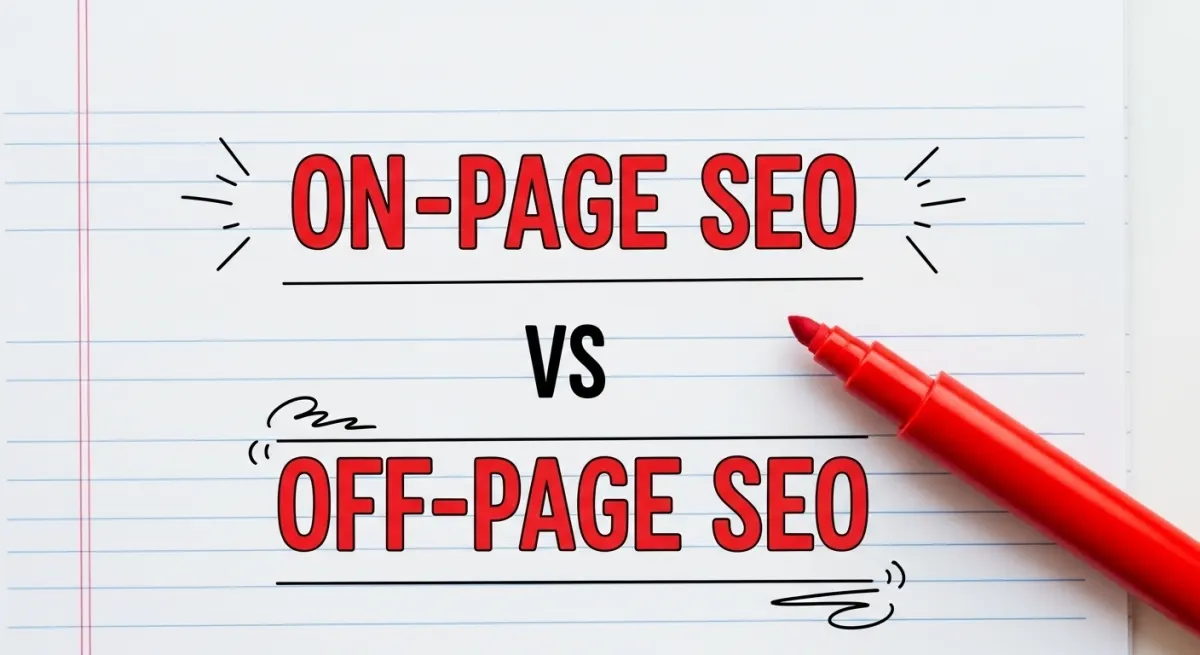
Notebook paper showing "ON-PAGE SEO vs OFF-PAGE SEO" in bold text, with a red marker beside it, illustrating a comparison of SEO strategies.

7 min read

On-Page SEO vs Off Page SEO: Key Differences Explained

Key Highlights On-page SEO is all about improving individual web pages using elements like meta tags, title tags, and internal links to achieve better search engine rankings. Off-page SEO focuses on external activities, such as social media strategies and link building, to bolster domain authority and reputation. Both strategies contribute to your search engine optimization efforts, acting as critical ranking factors. On-page SEO allows direct management over page content and structure, adapting it to match search intent. Off-page SEO builds organic traffic by enhancing the website's credibility and visibility through external signals. Overview Search engine optimization (SEO) is the backbone of enhancing visibility on search engine results pages. Every effective SEO strategy includes two interconnected approaches: on-page SEO and off-page SEO. These methods focus on different factors to improve rankings and drive organic traffic. On-page tactics optimize content directly on your website, while off-page strategies elevate your domain’s authority through external interactions like social media and backlinks. A well-rounded SEO strategy ensures your web presence is as robust as possible. Understanding SEO: The Two Pillars SEO, or search engine optimization, revolves around improving your website's position in search results. It essentially breaks into two foundational pillars: on-page SEO and off-page SEO. On-page SEO focuses primarily on elements you can directly manage within your website, such as headers, internal links, and page content. Off-page SEO, however, depends on external factors that solidify your site’s reputation, like backlink acquisition and social media. These approaches complement each other to form a complete SEO strategy. Defining On-Page SEO On-page SEO, also referred to as on-site SEO, involves the technical and creative elements of your web pages that help search engines understand their content. This includes optimizing page elements like title tags, headers, and internal links to improve search engine rankings. For instance, focusing on meta descriptions and well-structured headers not only boosts your website’s visibility but ensures search intent aligns with the user experience. Page structure, URLs, and keywords further signify relevance to search engines, making them integral to on-page optimization. Another key aspect lies in internal links. It’s about guiding users effortlessly through connected, meaningful content within your site. This, paired with keyword-rich and accessible elements, makes on-page SEO crucial for ranking higher on search engines while delivering user-friendly web pages. Defining Off-Page SEO Off-page SEO pertains to activities conducted outside your website but directly impacting its authority and credibility. Link building, as an example, is central to this strategy. Quality backlinks signal relevance and trustworthiness to search engines, increasing rankings. In addition to links, brand awareness plays a major role. Social media interactions and unlinked brand mentions show your website's influence and create traffic funnels. Efforts like guest blogging and influencer outreach further enhance visibility by establishing relationships with other trusted entities. Think of it this way: while on-page SEO builds the foundation, off-page SEO acts as the bridge of trust with the web. A comprehensive off-page strategy develops your reputation, ensuring long-term search engine optimization success. Core Elements of On-Page SEO Critical aspects of on-page SEO involve strategic incorporation of relevant keywords and meta tags. Keywords ensure your pages align with user search queries, directly supporting your SEO strategy. Simultaneously, meta tags like title tags and meta descriptions serve as previews in search engine results, enticing users while signaling content relevance. These combined elements strengthen the quality of your website's optimization, paving the way for improved rankings and better user engagement. With these foundations clarified, let’s examine specific aspects of on-page optimization. Optimizing Title Tags and Meta Descriptions Title tags and meta descriptions play a pivotal role in enhancing search visibility. Title tags are the brief texts highlighted on browser tabs and search results pages, showcasing the subject of your webpage. Incorporating target keywords into your title tags boosts relevance, especially when pushed closer to the beginning. Meta descriptions, on the other hand, are compact summaries appearing below title tags on search results. These snippets should be persuasive yet informative, urging users to click through to your page by setting expectations. While the ideal title tag length is under 60 characters, meta descriptions should ideally stay below 155 characters. These limits ensure both elements are fully displayed across devices, maximizing their impact. Optimized title tags and meta descriptions directly improve ranking potential and click-through rates. Structuring Content with Headers (H1, H2, H3) Effective content structuring using header tags (H1, H2, H3) is crucial for improving user experience and enhancing search engine optimization. H1 tags serve as the primary title, encapsulating the essence of the page. H2 tags can denote main sections, guiding readers through the content, while H3 tags help to organize subsections, ensuring clarity and focus. Utilizing these header tags appropriately not only aids in content hierarchy but also plays a significant role in search engine rankings. Search engines favor well-structured content, making it easier for users to find relevant information, thus driving organic traffic. URL Structure and Internal Linking An organized URL structure aids both users and search engines in understanding what lies within your pages. Key phrases, keywords, and a logical format not only improve navigation but also foster better indexing. Internal linking further strengthens your on-page SEO as it guides visitors to related pages, boosting site retention. Links embedded in strategic anchor text maximize relevance between the connected content. Make use of URLs to signal website hierarchy. Avoid keyword overstuffing and prioritize brevity and clarity. Paired with efficient internal linking, such strategies improve site structure and accessibility. Image Optimization and Alt Text Images play an essential role in user experience and page content presentation. Optimizing these visuals involves reducing file size for quicker page loads and adding descriptive alt text. Alt text provides added context for search engines and enhances web accessibility. Including relevant keywords in alt attributes strengthens on-page SEO by underlining image relevance. Ensure the descriptions are clear and useful without being overly technical. This two-fold strategy combines visual appeal with search engine optimization improvements, fostering better rankings and user experiences. Technical Aspects of On-Page SEO Some technical elements heavily influence on-page SEO performance. Page speed, for instance, is crucial; Google prioritizes websites with faster load times. Tools like PageSpeed Insights highlight potential fixes. Core Web Vitals offer metrics that quantify user satisfaction. From visual stability to interactive responsiveness, optimizing technical aspects ensures streamlined functionality across devices. With technical SEO as a backbone, let’s dive deeper into key implementation elements. Mobile Friendliness and Responsive Design With mobile devices dominating web browsing, responsive design is non-negotiable. Ensuring your site adapts seamlessly across screens enhances user experience and impacts rankings positively. The core of mobile-friendliness lies in intuitive navigation and clickable elements suited to smaller devices. Google Search Console provides insights into improving mobile pages using tools like Core Web Vitals monitoring. Building responsive websites boosts accessibility, making every mobile visit frictionless and satisfying. Improving Page Load Speed Page speed is influential in SEO rankings because a quicker load time elevates user satisfaction. Evaluate speed metrics using Google’s PageSpeed Insights. Simple fixes, such as minimizing HTTP requests or enabling browser caching, significantly accelerate load times. Removing bloated scripts improves First Input Delay, ensuring users interact swiftly with your site. Efforts to optimize page speed improve overall site functionality and bolster search engine positioning. Implementing Schema Markup and Core Web Vitals Schema markup adds structured data, enabling Google to provide rich search results for your pages. JSON-LD format is highly recommended by Google for formatting schemas effectively. Core Web Vitals like Largest Contentful Paint (LCP) measure page loading, and Cumulative Layout Shift (CLS) tracks content stability. Addressing spreadsheet adjustments, lazy loading, or added dimensions can optimize these elements. Strengthening these aspects solidifies both search engine rankings and user experience. Key Factors in Off-Page SEO Off-page SEO ensures your website gains reputation with external support, primarily via backlinks. Quality outweighs quantity, as effective link-building strategically targets trustworthy sites. Social signals, such as brand mentions or shares, amplify your credibility further through digital advocacy. Together, these techniques shape how search engines perceive your authority. With the importance of external dynamics clear, let us explore off-page implementations. Building High-Quality Backlinks Backlinks represent key elements boosting your site’s domain authority. Engaging in guest blogging or creating shareable resources attracts credible links. Anchor text on inbound links should feature primary keywords, enhancing context and relevance. Tools like domain authority trackers ensure your benchmarks align with competitors. Prioritizing quality backlinks nurtures sustained ranking improvements while affirming your website's trustworthiness. Social Signals and Brand Mentions Social media marketing plays a core role in generating social signals. More shares reflect viewer trust, increasing SEO ranking indirectly. Brand mentions can be linked or unlinked. Both serve as markers indicating your growing reputation. Interactive campaigns resonate deeply with audiences, resulting in positive signals. Building social signals prominently impacts organic visibility and traffic generation. Guest Posting and Influencer Outreach Collaborative strategies like guest blogging expand content reach beyond your website. Influencer partnerships further ignite awareness, driving users to explore your linked pages. These techniques reflect expertise while demonstrating relevance in targeted domains. Generate new content collaboratively and maintain mutual credibility through structured linking. Guest post projects and strategic outreach mark impactful and authentic expansions in reputation management. Comparing On-Page and Off-Page SEO On-page SEO focuses on your website's internal elements—optimizing meta tags, headers, and page structuring for better search visibility. Off-page SEO takes external actions like link building and social media outreach, reinforcing domain trustworthiness. Both approaches play unique roles in every SEO strategy, shaping your website rankings efficiently. Let’s compare their significance further in terms of rankings and strategy configurations. Impact on Search Engine Rankings On-Page SEO Off-Page SEO Direct control over content External reputation building using backlinks and mentions Targets search intent to improve relevant rankings Boosts domain credibility for higher placement Technical factors like speed and layout affect positioning Reacts strategically with niche collaborations for links This text table highlights their roles, underscoring their complementary nature in dominating search engine results pages. Control and Implementation Differences On-page SEO requires adjustments within your website—meta tags, headers, and HTML structure—all fruitful on short timelines. Off-page SEO implementation relies on external interactions, from affiliate recommendations to broad marketing campaigns. Their timelines often span long-term visibility. Implementing these techniques clarifies their roles and adaptability in balancing your SEO tactical objectives. Short-Term vs. Long-Term Benefits Immediate impacts arise from on-page optimizations as visible search rankings improve. Off-page mechanisms like quality backlinks create sustainable, long-lasting traffic pipelines expanding domain recognition. These benefits, though gradual, foster enduring credibility. Best practices align both strategies, forging pathways switching between quick wins and sustained successes with SEO markets. Integrating On-Page and Off-Page Strategies for Best Results A well-rounded SEO strategy combines rigorous on-page refinements with dynamic off-page efforts. Such integration harmonizes search visibility with external trust, targeting both user engagement and search intent. Balancing these practices reflects impactful SEO planning tailored toward sustainable success. Within this trajectory lies creating a solid plan while avoiding common pitfalls. Creating a Balanced SEO Plan Start with target audience research. Define keywords by analyzing competitor strategies and market queries. Focus equally on each category of on and off-page SEO elements. On-page refinements address immediate visibility. Leverage off-page relationships amplifying broader traffic drivers. Plans incorporating steady adjustments refine these connections further, producing balanced outcomes matching expectations within refined SEO steps. Common Mistakes to Avoid Mistakes often undermine optimizations—common issues include: Keyword stuffing decreases relevance of your content, repelling search engines. Ignoring user experience signals dissuade engagement. Neglecting technical speed features slows page visibility momentum. Over-prioritising link quantity discounts organic credibility. Avoid these traps tactfully, strengthening underlying SEO campaign formations better positioned for corrections without compromises fermenting negative equity. Elevate Your SEO Strategy! Understanding the differences between on-page and off-page SEO is essential for crafting a comprehensive strategy that enhances your website's visibility. On-page SEO focuses on optimizing individual web pages to improve their search engine rankings, while off-page SEO encompasses external factors such as backlinks and social signals that can elevate your site's authority. By integrating both strategies, you can achieve a balanced SEO approach that drives long-term results. Remember, successful SEO is not just about quick fixes; it's about creating a sustainable plan that aligns with your business goals. Ready to build a comprehensive SEO plan that drives traffic and boosts your rankings? Contact us today for a personalized consultation and let's unlock your website's full potential. Frequently Asked Questions {% module_block module "widget_b345c53b-75da-4d99-b79b-77be7e124d7e" %}{% module_attribute "accordion_item" is_json="true" %}{% raw %}[{"body_text":" On-page SEO involves optimizing elements within your website, such as content and meta tags, to improve its visibility. \n In contrast, off-page SEO focuses on external factors like backlinks and social media presence that influence your site's authority and ranking. ","header_text":"What is the primary difference between on-page and off-page SEO?"},{"body_text":" While on-page SEO is crucial for search engine visibility, relying solely on it may not yield high rankings. \n Effective SEO strategies should also incorporate off-page techniques, such as backlinking and social media engagement, to enhance overall authority and performance in search results. ","header_text":"Can you rank well with only on-page SEO?"},{"body_text":" Results from off-page SEO can take anywhere from a few weeks to several months to manifest. \n The timeline depends on various factors, including the competitiveness of your niche, the quality of backlinks acquired, and your overall SEO strategy. Consistency is key to seeing sustainable results. ","header_text":"How long does it take to see results from off-page SEO?"}]{% endraw %}{% end_module_attribute %}{% module_attribute "child_css" is_json="true" %}{% raw %}{}{% endraw %}{% end_module_attribute %}{% module_attribute "css" is_json="true" %}{% raw %}{}{% endraw %}{% end_module_attribute %}{% module_attribute "definition_id" is_json="true" %}{% raw %}null{% endraw %}{% end_module_attribute %}{% module_attribute "field_types" is_json="true" %}{% raw %}{"accordion_item":"group","allow_multiple_to_be_open":"boolean","faq_section":"boolean","opening_speed":"number","style":"group"}{% endraw %}{% end_module_attribute %}{% module_attribute "label" is_json="true" %}{% raw %}null{% endraw %}{% end_module_attribute %}{% module_attribute "module_id" is_json="true" %}{% raw %}124560241784{% endraw %}{% end_module_attribute %}{% module_attribute "path" is_json="true" %}{% raw %}"@marketplace/Bootstrap_Creative/Accordion_FAQ"{% endraw %}{% end_module_attribute %}{% module_attribute "schema_version" is_json="true" %}{% raw %}2{% endraw %}{% end_module_attribute %}{% module_attribute "smart_objects" is_json="true" %}{% raw %}[]{% endraw %}{% end_module_attribute %}{% module_attribute "smart_type" is_json="true" %}{% raw %}"NOT_SMART"{% endraw %}{% end_module_attribute %}{% module_attribute "style" is_json="true" %}{% raw %}{"header_text":{"heading_html_tag":"h3"}}{% endraw %}{% end_module_attribute %}{% module_attribute "tag" is_json="true" %}{% raw %}"module"{% endraw %}{% end_module_attribute %}{% module_attribute "type" is_json="true" %}{% raw %}"module"{% endraw %}{% end_module_attribute %}{% module_attribute "wrap_field_tag" is_json="true" %}{% raw %}"div"{% endraw %}{% end_module_attribute %}{% end_module_block %}

Read More
Magnifying glass over a paper with "SEO" encircled by red arrows, symbolizing search engine optimization analysis and focus.

8 min read

What Is Off-Page SEO? Essential Strategies for 2025

Key Highlights Off-page SEO expands your website’s visibility and reputation beyond its own pages. Engaging on social media platforms boosts both your brand credibility and SEO signals. Positive online reviews foster trust and enhance local SEO potential. Implementing effective off-page SEO strategies can significantly improve search engine rankings. Brand mentions and influencer collaborations effectively improve authority and broaden audience reach. Overview Off-page SEO is a vital element of modern search engine optimization. While it operates outside your website, it plays a pivotal role in improving digital visibility and driving search engine results. In today’s competitive landscape, crafting an effective SEO strategy means honing your off-page efforts to boost your online profile. From link building to leveraging reviews, off-page components directly impact your site’s reputation and rankings. Let’s explore the role of off-page SEO in digital marketing for 2025. Understanding Off-Page SEO in 2025 Off-page SEO involves all optimization strategies that enhance a website’s visibility and authority beyond its pages. As Google continuously refines its algorithms, its reliance on off-site signals, such as backlinks and brand mentions, remains firmly intact. Digital marketing now prioritizes credibility-building initiatives like social media campaigns and collaboration with authoritative sources. To achieve high search engine rankings, off-page SEO advances as a cornerstone factor, combining strategic efforts that help establish trustworthiness and relevancy. Definition and Core Concepts Off-page SEO encompasses methods that boost a site’s authority and visibility, with strategies implemented externally. One notable technique is link building , where high-quality backlinks signal trustworthiness to search engines. Links from authoritative websites act like endorsements, improving rankings dramatically. Social media is another integral component. Interactions on platforms like Instagram and Facebook amplify brand mentions and reach. SEO specialists also use campaigns to tap into new audiences while driving traffic to a website. Brand mentions are yet another critical concept. Whether cited on forums, blogs, or news sites, these mentions build credibility and boost visibility. They function as powerful markers of authority and authenticity. Off-page SEO ensures that your brand is not limited to your site but flourishes across the digital ecosystem. How Off-Page SEO Has Evolved Off-page SEO from years past emphasized basic link-building tactics, yet modern methods focus on quality over quantity . Today, Google’s ranking factors reward natural links created through content marketing rather than spammy backlinks. Search engines prioritize sites fostering genuine brand awareness. Digital marketers now shift efforts toward relevance; compelling campaigns and guest blogging support enhanced connections. Quality backlinks reflect meaningful engagements that resonate well with audiences and search engines alike. Content marketing has also become a linchpin. By creating valuable resources, businesses attract organic links while cultivating relationships across industries. Off-page optimization today is more sophisticated, emphasizing trust and credibility throughout your digital interactions. The Importance of Off-Page SEO for Modern Websites Modern websites rely on off-page SEO for sustainable search engine rankings. This approach complements on-page techniques to drive your brand name and online presence forward. Google uses off-page indicators like backlinks and mentions to evaluate trustworthiness. Studies further highlight how off-page signals improve ranking potential. Positive measures position your site as authoritative among competitors, boosting visibility and traffic. Now more than ever, off-page SEO is indispensable for achieving long-term digital success. Impact on Search Rankings Search rankings are heavily influenced by off-page SEO factors. High-quality backlinks, for instance, directly signal Google rankings that your content offers value. Metrics like anchor text and referring domains play essential roles in determining effectiveness. Tools like a backlink analytics tool bring clarity to your SEO initiatives by letting you track incoming links, their relevance, and origin. Pages with backlinks from prominent sources consistently outperform, as their trust metrics surpass competing sites. Moreover, backlinks must be naturally built to avoid penalties. Google favors links from authoritative websites because these signify genuine votes of confidence. Robust backlink profiles pay off through increased visibility in competitive queries. Building Online Authority and Trust Authority-building begins with strategic off-page SEO measures that reinforce trust among users and search engines alike. Brand mentions across authoritative websites add credibility and signal expertise. These references reflect the reliability of your content and offerings. Positive reviews serve as vital markers for establishing trust. They influence potential customers and show both Google and users that your business is dependable. Online reputation matters when trying to connect with audiences authentically. Collaborating with influential content creators fosters brand awareness while generating high-quality links. Each partnership, review, or connection adds to an entity’s perceived professionalism. Strategic efforts ensure consistency in signals across the digital sphere. Key Differences Between On-Page and Off-Page SEO On-page and off-page SEO form two distinct components within search engine optimization . On-page SEO addresses internal aspects, including technical SEO fixes and content improvements. Meanwhile, off-page SEO relies on external factors like backlinks and reviews. Holistic SEO strategies combine both methods for full optimization. On-page improvements handle page relevance while external indicators boost credibility. Address both fields to outmaneuver competitors effectively. Elements of On-Page SEO On-page SEO relies on optimizing elements within a website for greater search visibility: Title tags : Ensure every page features relevant, concise titles to attract clicks. Target keywords : Embed keywords strategically within headings and content for search relevancy. Helpful content : Focus on providing clear answers and engaging materials to retain visitors. Technical SEO : Utilize tools like Google Search Console to pinpoint and rectify errors effectively. By refining these elements, websites can sustain higher rankings and improved user experiences. Distinctive Features of Off-Page SEO Off-page SEO thrives on external strategies to boost online reputation: Quality link building enhances visibility and search engine rankings. Guest blogging on high-authority websites expands audience reach while supporting credibility. Brand mentions across platforms reinforce your presence and trustworthiness. Gathering online reviews enhances local relevance and search results credibility. These components fortify your brand’s ecosystem externally, ensuring holistic SEO success. Core Off-Page SEO Strategies for 2025 Investing in off-page SEO shelters your site’s credibility while improving search performance. In 2025, link-building , content marketing , and nurturing partnerships remain essential strategies. Digital marketing agencies recommend prioritizing natural links and influencer collaborations to amplify reach. Combining these efforts with meticulous review and reputation management elevates your SEO strategy comprehensively. Link Building – Quality Over Quantity Effective link-building revolves around securing backlinks from trusted sources. Search engines value high-quality links over sheer numbers. A natural link from authoritative sites nurtures credibility more than thousands of weak connections. Techniques like email outreach help initiate connections with influencers or businesses that align with your brand. Focus on crafting compelling resources that others find worth linking to, a strategy that withstands algorithm updates. SEO is better served by prioritizing trustworthiness over shortcuts. Content Marketing Beyond Your Website Expanding content marketing outside your primary domain enhances off-page SEO. By engaging in guest posting on news sites and blogs, brands gain visibility and link equity. Publishing a compelling piece of content boosts credibility, especially when shared on high-traffic platforms. Consistently producing valuable content builds an engaged audience that’s willing to amplify reach further. SEO strategies now incorporate diversified content channels to maximize exposure, improving both rankings and reputation simultaneously. Advanced Link Building Techniques Modern advanced link-building methods focus on precision and adaptability. Tactics like broken link building ensure replacement links satisfy site owners while adhering to search engine ranking factors . Meanwhile, email outreach provides a direct method for cultivating partnerships that sprout naturally influential backlinks. These strategies prove indispensable for optimizing complex SEO campaigns effectively. Guest Posting on High-Authority Sites Strategic guest posting elevates off-page SEO success. Pairing on carefully selected high-authority sites develops credibility and trust across wider audiences. With content creators , dynamic partnerships emerge, helping businesses augment their digital scope. Insights shared adeptly convert to visits and brand awareness alike. Integrating digital marketing within postings ensures visibility across platforms, guaranteeing consistent authoritative results for search engines alike. Broken Link Building and Reclaiming Links SEO practitioners utilize broken link building to replace defunct backlinks with live content. Leveraging a backlink analytics tool helps identify potential opportunities quickly. These tactics bring mutual benefit between creators and publishers alike. Simultaneously, efforts to reclaim links from authoritative websites refine backlink portfolios for superior search engine results. Collaborations within industries amplify credibility long-term. Leveraging Social Media for Off-Page SEO Social media platforms serve as instrumental channels for driving off-page SEO initiatives. Amplified social media shares promote content far beyond primary audiences or networks. Coupled with brand name mentions, SEO boosts cumulatively reinforce online presence holistically. Each shared post functions powerfully in expanding reach seamlessly. Amplifying Content Reach Social media marketing leverages networks for persistent engagement with audiences. Sharing a piece of content attracts clicks while bolstering visibility. Platforms stand pivotal in aiding brand awareness , representing far-reaching reputations globally. By fine-tuning strategy, campaigns invigorate success rapidly across such opportunities. SEO strategies benefit from these approaches holistically toward sustained social elevation toward higher-impact outcomes reflective immediately through long-term efforts alike. Engaging Influencers and Communities Influencer marketing taps niche groups through sponsored campaigns, coupling promotion alongside content creators , bloggers innovatively instilling branded trust amongst followers. Encapsulating functionalities per social media platforms , approaches dynamically improve keyword relevancies long-term. Results showcase incredible returns, gaining attention quicker comparatively applying additionally smoother transition success simultaneity. Utilize exclusivity for personalized brilliance leveraging deserved engagement SEO intact throughout resulting figures dynamically tracking exceptional returns across transitions seamless proficiencies similarly over time. Online Reputation Management A robust online reputation management strategy involves actively shaping how a brand is perceived across various platforms. Engaging with potential customers through social media platforms is essential, as it fosters brand awareness and encourages interaction. In addition to managing online reviews, utilizing SEO techniques like guest posting and monitoring brand mentions promotes positive narratives about your brand. Influencer marketing can also enhance credibility, elevating the overall search engine rankings and ensuring your business remains visible and attractive to your target audience. Encouraging Positive Reviews An effective strategy for increasing positive reviews involves engaging customers through various communication channels. By leveraging social media platforms and email outreach, businesses can encourage satisfied clients to share their experiences. Providing an easy way for customers to leave reviews on sites like Google Business Profile not only enhances brand visibility but also positively influences search engine rankings. Highlighting user-generated content through guest blogging and influencer marketing can further boost credibility and brand awareness, driving more potential customers towards favorable online interactions. Monitoring Brand Mentions and Responding Keeping tabs on brand mentions is crucial for maintaining a strong online presence. Utilizing tools such as Google Alerts or specialized backlink analytics tools can help track conversations about your brand across various platforms. Timely responses not only build brand awareness but also demonstrate your commitment to customer satisfaction. Engaging with customers through these interactions, whether positive or negative, showcases your responsiveness. This practice not only strengthens relationships but enhances your search engine optimization strategy by improving overall brand sentiment, thereby potentially influencing search engine rankings. Local SEO and Off-Page Signals Strong off-page signals play a crucial role in any local SEO strategy. Building citations and local listings not only improves visibility but also helps potential customers find your business easily. Engagement is key; managing local reviews fosters community interaction, enhancing brand loyalty while boosting your search engine rankings. The quality of backlinks from authoritative websites can amplify your online presence, making it more likely for your brand to appear in search results. Utilizing effective techniques, including influencer marketing and broken link building, can drive your local SEO efforts forward. Building Citations and Local Listings Creating accurate citations and local listings is essential for enhancing your visibility in search engine results. This process involves ensuring your business information, such as your name, address, and phone number, is consistent across various platforms like Google Business Profile, Yelp, and other authoritative directories. Engaging in local SEO strategies helps potential customers easily find your business, contributing to better search engine rankings. Furthermore, effective link-building through local business partnerships can reinforce your online presence and elevate brand awareness in the community. Managing Local Reviews and Community Engagement An active approach to managing local reviews fosters a strong connection with your community, creating trust and enhancing brand awareness. Engaging with feedback—both positive and negative—demonstrates your commitment to customer satisfaction and encourages further interactions. Leveraging social media platforms can amplify your response efforts, allowing for real-time engagement and relationship building. Incorporating keywords related to your services within your responses can also improve local SEO. Cultivating meaningful relationships through community engagement ensures a solid online presence, ultimately leading to increased search engine rankings and a loyal customer base. Elevate Your SEO Strategy! Successful off-page SEO strategies are essential for enhancing visibility and driving traffic. By focusing on online reputation management, local SEO, and effective link building, businesses can boost their search engine rankings and attract potential customers. Engaging with audiences through social media platforms, curating valuable content, and managing online reviews can significantly elevate brand awareness. Implementing these tactics not only aids in achieving better search results but also fosters a trustworthy online presence, ultimately positioning businesses for long-term success and improved search engine optimization outcomes. Let The Way How craft a powerful off-page SEO strategy tailored to your business. Our comprehensive SEO services are designed to elevate your brand authority, drive organic traffic, and secure your competitive edge. Explore Our SEO Services Today and Start Outranking Your Competition! Frequently Asked Questions {% module_block module "widget_e2ce3b67-097c-496f-a7f4-0a57c48e2c5d" %}{% module_attribute "accordion_item" is_json="true" %}{% raw %}[{"body_text":" The biggest off-page SEO trend for 2025 centers around enhancing user experience through brand authenticity and transparency. \n Emphasizing community engagement and fostering genuine connections can significantly impact link-building strategies and boost online reputation, driving organic traffic and improving search rankings. ","header_text":"What is the biggest off-page SEO trend for 2025?"},{"body_text":" Google evaluates off-page signals by analyzing backlinks, social media engagement, brand mentions, and user-generated content. \n Quality and relevance of these signals play a significant role in determining a website's authority and trustworthiness, ultimately influencing its rankings in search results. ","header_text":"How does Google evaluate off-page signals?"},{"body_text":" Common mistakes in off-page SEO include neglecting social media engagement, failing to diversify backlink sources, ignoring local citations, and not monitoring brand mentions. \n Additionally, businesses often overlook the importance of quality over quantity in link building, which can hinder their overall search visibility. ","header_text":"What are the most common mistakes in off-page SEO?"}]{% endraw %}{% end_module_attribute %}{% module_attribute "child_css" is_json="true" %}{% raw %}{}{% endraw %}{% end_module_attribute %}{% module_attribute "css" is_json="true" %}{% raw %}{}{% endraw %}{% end_module_attribute %}{% module_attribute "definition_id" is_json="true" %}{% raw %}null{% endraw %}{% end_module_attribute %}{% module_attribute "field_types" is_json="true" %}{% raw %}{"accordion_item":"group","allow_multiple_to_be_open":"boolean","faq_section":"boolean","opening_speed":"number","style":"group"}{% endraw %}{% end_module_attribute %}{% module_attribute "label" is_json="true" %}{% raw %}null{% endraw %}{% end_module_attribute %}{% module_attribute "module_id" is_json="true" %}{% raw %}124560241784{% endraw %}{% end_module_attribute %}{% module_attribute "path" is_json="true" %}{% raw %}"@marketplace/Bootstrap_Creative/Accordion_FAQ"{% endraw %}{% end_module_attribute %}{% module_attribute "schema_version" is_json="true" %}{% raw %}2{% endraw %}{% end_module_attribute %}{% module_attribute "smart_objects" is_json="true" %}{% raw %}[]{% endraw %}{% end_module_attribute %}{% module_attribute "smart_type" is_json="true" %}{% raw %}"NOT_SMART"{% endraw %}{% end_module_attribute %}{% module_attribute "style" is_json="true" %}{% raw %}{"header_text":{"heading_html_tag":"h3"}}{% endraw %}{% end_module_attribute %}{% module_attribute "tag" is_json="true" %}{% raw %}"module"{% endraw %}{% end_module_attribute %}{% module_attribute "type" is_json="true" %}{% raw %}"module"{% endraw %}{% end_module_attribute %}{% module_attribute "wrap_field_tag" is_json="true" %}{% raw %}"div"{% endraw %}{% end_module_attribute %}{% end_module_block %}

Read More
Phone displaying social media apps.

9 min read

Mastering Social Media Marketing With HubSpot

Key Highlights Learn how HubSpot can revolutionize your social media strategy. This guide explores HubSpot's tools for crafting engaging campaigns, scheduling content, and analyzing performance across platforms like Facebook, Instagram, Twitter, and LinkedIn. We'll streamline setting up your dashboard and integrating your social channels. Discover how to tailor your content for your specific audience, optimize for maximum engagement, and use analytics to refine your approach. This comprehensive guide empowers you to elevate your social media presence and achieve tangible results. Overview This guide explores mastering social media marketing using HubSpot, a powerful tool that streamlines managing your social media presence across various platforms.

Read More
marketing team discussing how HubSpot can help with their marketing.

5 min read

HubSpot CRM: Elevate Your Marketing

Key Highlights HubSpot CRM offers a suite of free tools designed to streamline and enhance marketing efforts. From email marketing and social media integration to analytics and automation, HubSpot CRM empowers marketers to optimize their strategies. Seamless integration with popular marketing tools ensures a centralized platform for managing customer data and interactions. A user-friendly interface and a wealth of resources make HubSpot CRM accessible to businesses of all sizes. Regularly updating customer data and leveraging insights are crucial for maximizing the return on your HubSpot CRM investment. Overview HubSpot CRM stands out as a dynamic platform that empowers businesses to nurture leads, enhance customer relationships, and drive revenue growth through intelligent automation and data-driven insights.

Read More
A smart phone displaying different social media apps.

3 min read

Boost Your Mobile Marketing With HubSpot

Key Highlights Learn how mobile marketing can significantly boost your business growth. Discover the importance of integrating HubSpot in your mobile marketing strategy. Enhance user experience and engagement with mobile users through HubSpot. Streamline campaign management with HubSpot's automation and personalization features. Gain insights into leveraging HubSpot for SMS marketing and email campaigns. Maximize brand visibility and drive successful mobile campaigns with HubSpot. Overview With the increasing use of mobile devices, mobile marketing has become an essential aspect of any successful marketing strategy.

Read More
Marketing manager working on projects within HubSpot.

6 min read

Mastering HubSpot's Marketing Automation

Key Highlights Streamline your marketing efforts and boost efficiency with HubSpot's powerful marketing automation tools. Design targeted email workflows, personalize content, and nurture leads effectively to enhance conversions. Integrate social media seamlessly to expand your reach and engage your target audience effortlessly. Leverage HubSpot's analytics and reporting features to gain actionable insights and optimize your campaigns continuously. Explore a comprehensive marketing solution with HubSpot, encompassing email marketing, CRM, social media management, and more. Overview HubSpot has emerged as a leading platform empowering businesses to optimize their marketing efforts. With its robust marketing automation capabilities, HubSpot allows you to streamline various aspects of your marketing strategy.

Read More
Image showing marketing KPIs.

7 min read

Mastering HubSpot Inbound Marketing Strategies

Key Highlights Attract, Engage, and Delight: Learn the core principles of inbound marketing for sustainable business growth. HubSpot Tools for Success: Utilize HubSpot's powerful tools designed to attract, engage, and delight your target audience. Content is King: Discover the significance of valuable content in attracting and engaging your ideal customers. Data-Driven Optimization: Leverage HubSpot's analytics to refine your inbound strategies and maximize your return on investment. From Traffic to Advocacy: Transform website visitors into loyal customers and brand advocates through effective inbound techniques. Overview Unlike traditional outbound techniques, inbound marketing focuses on attracting customers organically through valuable content and personalized experiences.

Read More